Showing posts with label Islamophobia. Show all posts

Friday, September 20, 2024

Making Our Votes Count for America

As the November 5 presidential election draws closer, reviewing our recent history, if only as a reminder, can give the perspective we need to cast our votes, not as Democrats or Republicans or belonging to Red, Blue, or Swing States, but as Americans.

In 2016, Donald Trump beat Hillary Clinton to become the 45th President of the United States, winning the Electoral College by 304 to 227, even though Clinton won the popular vote by almost 3 million.

In 2020, Joe Biden beat Donald Trump to become the 46th President of the United States, winning the Electoral College by 306 to 232 and the popular vote by almost 7 million. Trump refused to accept the verdict of the American people and incited an insurrection on January 6, 2021, by his armed supporters at the U.S. Capitol, a date which will live in infamy alongside Japan’s Pearl Harbor attack on December 7, 1941.

Four years on, and for the third time in a row, Donald Trump is running as the Republican nominee for the presidency of the United States, this time against the Democratic nominee Kamala Harris. We are reliving the old saying: “The more things change, the more they stay the same.”

Antisemitism, Islamophobia, dehumanization of immigrants and conspiracy theories continue to fester in our country. To the more than 67 million viewers watching the Harris-Trump debate on September 10, the former president asserted the debunked claim that Haitians in Springfield, Ohio, were eating their neighbors’ pets. At a news conference three days later, he threatened to enact the largest deportation of migrants in the nation’s history if elected. Mike DeWine, the Republican Governor of Ohio, said this about Haitians in his state: “Springfield is having a resurgence in manufacturing and job creation. Some of that is thanks to the dramatic influx of Haitian migrants who have arrived in the city over the past three years to fill jobs. They are there legally. They are there to work.”

America has rarely been as polarized as it is on the eve of the 2024 election. Partisan politics is crippling us. We are grappling with the same foundational values of our nation such as democracy, the rule of law, checks and balances, and the peaceful transfer of power as during Trump’s presidency. Add to these other issues like reproductive freedom (supporting legal abortion despite the moral reservations some of us may have about it), climate change, affordable healthcare, housing and clean energy, gun control and artificial intelligence-generated misinformation, and we understand why the 2024 presidential election may be among the most consequential elections in living memory.

The contrast between the views of Kamala Harris and Donald Trump on these and other issues couldn’t be starker, available online and in print to discerning Americans weighing who to vote for, especially the undecided and the callously indifferent among us. As Taylor Swift wrote in her Instagram message endorsing Kamala Harris to her fans, “I’ve done my research, and I’ve made my choice. Your research is all yours to do, and the choice is yours to make.”

The presidency is not only about policies and procedures or tariffs and trade but also about civility and morality, honesty and integrity, among other character codes. We will do well to remember and act on Ronald Reagan’s vision for America: “We shall be as a city upon a hill.” We will do well to remember Abraham Lincoln’s words from his first inaugural address in 1861 as a Civil War loomed: “We are not enemies but friends … touched by the better angels of our nature.”

Lincoln’s words did not prevent a Civil War from erupting and dragging on for four ruinous years, with a death toll of over 600,000 Americans, about 2% of the U.S. population then. While a modern-day Civil War may be far-fetched, attempts by anyone to overturn the 2024 election if the results are contrary to expectations by inciting another insurrection can cause an unbreachable and permanent rift among us that can dangerously weaken our Republic.

So, when we vote on November 5 or earlier by mail, not just as a right but as a sacred obligation, we must summon the courage and the wisdom to place joy over anger, humility over hubris, compassion over cruelty, law over anarchy, science over ideology, democracy over authoritarianism and most of all, country over party.

Saturday, March 16, 2019

Terrorists Target Sacred Places

You can also read the article in the San Jose Mercury News.

One constant in my life as a Muslim-American is the Friday congregational prayers, a constant I share with many of my coreligionists. I organize my work and travel schedules around it so as not to miss this weekly spiritual experience. Known by the Arabic word Jumah (to gather together), the prayer is important for Muslims because of its emphasis in the Quran and because it brings the community together, from babies in strollers to the aged in wheelchairs. At our Evergreen Islamic Center in San Jose, an average of about 500 Muslims attend the Friday prayers.

In the last few years, with Islamophobia on the rise, I often found myself imagining my worst nightmare: One or more gunmen walk into the congregation and start mowing down worshipers. They could do this with impunity because most mosques have flimsy security, with one or two surveillance cameras at best.

My worst nightmare has just been realized, not in San Jose, CA, but in Christchurch, New Zealand, 7000 miles away. But it could just as easily have happened here.


I am thinking of Dylann Roof, the 21-year-old white supremacist who murdered nine African Americans in June, 2015, at the Emanuel African Methodist Episcopal Church in Charleston, SC. “I did what I thought would make the biggest wave,” he wrote, “and now the fate of our race is in the hands of my brothers who continue to live freely.” I am thinking of Robert Bowers who killed 11 worshipers in October, 2018, at the Tree of Life synagogue in Pittsburgh, PA. While receiving medical care from a Jewish physician, he said he wanted all Jews to die.

Now we have the 28-year-old Australian Brenton Tarrant, killer of at least 49 worshipers at two mosques in Christchurch this past Friday. He too is a white supremacist who wrote of his need to defend “our land” from “invaders” to ensure “a future for white children.” His online manifesto was starker: kill Muslim immigrants. During the carnage that he was streaming live, he was heard sayings: “There wasn’t even time to aim, there were so many targets.” He was shooting fish in a barrel, much like the white supremacist Anders Behring Breivik who killed 77 people in a bomb and gun rampage in July 2011 in Norway. For such fascists and fanatics, no school is too secular and no sanctuary too sacred.

What does this mean for Muslim-Americans? Do we believe Islamophobia and anti-Semitism is on the rise, with encouragement from on high? Yes, we do. 
Do we see white supremacy as an ideology that poses an existential threat for us? Yes, we do.

But will we let our fear and concern overwhelm our striving for a more inclusive society in America? No, we won’t.

At the same time, we have decided that lax security in our mosques is an invitation for disaster. At EIC, for instance, the board of directors is urgently laying plans for posting armed guards during every Friday prayers. With Ramadan less than two months away, security will also likely be beefed-up throughout the holy month. 

In San Jose, CA, we are heartened by the support from Mayor Sam Liccardo’s office and from police chief Edgardo Garcia who have promised more frequent patrol of our mosque. We hope this will become the norm throughout America until threats from terrorists of all persuasions are neutralized.

Muslim-Americans cannot afford the luxury of psycho-analyzing fascists like Brenton Tarrant or debating the finer points of the second amendment and gun rights. It’s a clear case of cause-and effect for us: More anti-Semitism, Islamophobia and racism, more killing of Jews, Muslims, African-Americans and minorities. We, therefore, resolve to strengthen our alliances even more with people of all faiths and no faith for a more inclusive and largehearted society in America.

Thursday, May 04, 2017

Unintended Consequences of Hate

You can also read the article here.

SAN JOSE, Calif. -- The pickup truck was following her. Dr. Sarah felt nervous but tried to convince herself it was just her imagination. He couldn’t possible know she was a Muslim, particularly since she was not wearing the optional hijab, the traditional Islamic head-cover to indicate modesty.

She pulled into the parking lot and got out of her car. The pickup slowed. As she crossed the street to get to her office, the driver, a middle-aged white man, rolled down the window and screamed at her: “Go back home!”

The heat of the man’s hate felt as if it were burning a hole in the back of her head. She ran to the safety of her hospital.

Dr. Sarah was born in Chicago to Muslim parents. After receiving a doctorate in psychology, she began working at a hospital in Silicon Valley in the pain management department as a psychologist, a job in which she has flourished for over a decade. When she reported the incident to her concerned supervisor, she advised her not to drive alone for a few weeks.

A week earlier, an engineer of Asian background, an American citizen, was confronted in the parking lot of a grocery store in San Jose by a driver who screamed: “Go back to where you came from.”

For many residents, the sprouting of bigotry in what is the heart of Silicon Valley, with a diversity of culture, religion and ethnicity rare in the world, is shocking.


“Before, I used to call my friends and relatives in India to ask if they were okay,” said Assemblyman Ash Kalra during a rally organized in response to the growing climate of fear following the election. “Now they call me to inquire if I am safe in Trump’s America!”

Trump has indeed loosened the shackles of bigotry among his supporters, emboldening them to threaten those who don’t look like them, and to hurl insults like, “Go back to where you came from!”

The Council on American-Islamic Relations (CAIR) has reported harassment and threats targeting Muslim women and children in Minnesota, North Carolina, New York and California in just the past two weeks alone. 

According to the Southern Poverty Law Center, there were 867 hate incidents in the ten days after Trump’s win in November. The advocacy group South Asians Leading Together (SAALT) put out a report in January that documented 207 hate incidents targeting South Asians, Muslims and Middle Easterners in 2016. The report noted the climate resembled the months following the 9/11 attacks, and attributed the spike in hate to campaign rhetoric during the 2016 race.

Here in San Jose, police documented four cases
 of crimes targeting Muslims in 2016. There were no cases prior in the years going back to 2011. Experts say the numbers are misleading, and that because victims are often reluctant to come forward, due to cultural or linguistic barriers, or because they are scared, the figures could be higher. 

One of those cases involved the Evergreen Islamic Center, where a letter was received just prior to the Thanksgiving holiday that read, in part: “There’s a new sheriff in town – President Donald Trump. He is going to cleanse America and make it shine again. And he’s going to start with you Muslims.” The letter went on to make reference to Nazi Germany, saying Trump would “do to you Muslims what Hitler did to the Jews.”


Still, despite the rising tide of Islamophobia, something remarkable began to happen among members of the local Muslim community in the days and weeks following Trump’s win. Having learned in the aftermath of 9/11 that a culture of shame and silence only promoted the politics of fear, area Muslims instead started forging bonds with community residents at a grass-roots level.

Several members of Evergreen (myself included) joined Indivisible East San Jose
one of nearly 6,000 Indivisible Groups that sprang up across the nation as a response and resistance to Trump’s presidency.

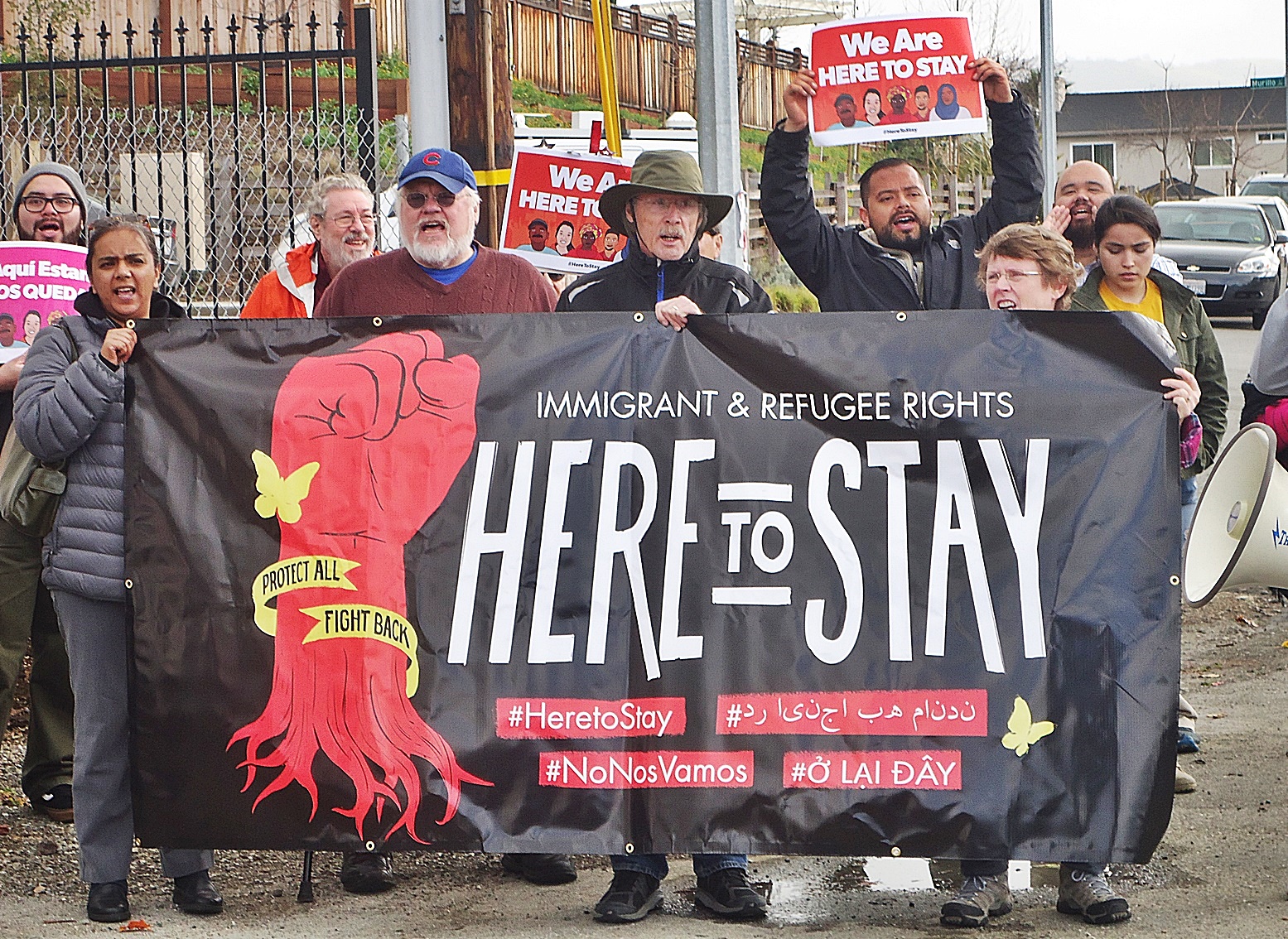
Meeting once every month, members knock on doors in San Jose’s depressed areas, informing undocumented workers, for example, of their rights if ICE shows up and the availability of free legal help. A few families in dire straits have been escorted to sanctuaries in synagogues and churches. 


On a recent Sunday afternoon, Evergreen teamed up with local Christians and Jews as members of Abrahamic Alliance at a church to prepare meals for the homeless and serve them across town at City Team San Josean organization that helps people struggling with poverty, homelessness and addiction. For many of us, this was our first experience with a soup kitchen. We were shocked to find that in one of the most prosperous areas in the world, there were people for whom a decent meal and a bed to sleep on were luxuries often beyond reach. We realized that more than mosques, we needed to build more soup kitchens and shelters for abused women, including Muslim women.


As remarkable is the growing outreach and solidarity extended to area Muslims from other immigrant
 communities. There have been several marches staged to commemorate the Japanese internment and to draw connections between that dark period in U.S. history and its echo against Muslims in Trump’s time. Meetings were held with Internment survivors who spoke of the importance of resistance.

Then there are the acts of individual kindness.

“Just think about it,” said Peggy, who drove an hour from the city of Santa Cruz with several friends in a show of solidarity with Evergreen following the recent threats. “Would we have even met if it were not for Trump? No! This is the silver lining in the dark cloud that hangs over our nation now.”

For local Muslims, the bridges now being formed in the era of Trump are a case of serendipity, the unintended but cathartic consequences of hate.

Tuesday, April 11, 2017

Ayaan Hirsi Ali Misunderstands Dawa Which is an Invitation to Fight Extremism


In a recent Wall Street Journal interview, author Ayaan Hirsi Ali warns of the threat posed by “Dawa,” an Islamic term that Hirsi Ali describes in her latest book as an even graver threat to liberal democracy than that posed by jihadi terrorism. What Hirsi Ali misses is that Dawa, as practiced by millions of Muslims in the United States, is an essential tool in the very fight against extremism.


Ayaan Hirsi Ali has an axe to grind against Islam and Muslims and up to a point, I understand it. 

She suffered genital mutilation as a child in Somalia where she was born into a devout Muslim family. She was exposed to a virulent form of misogyny in Saudi Arabia. She was briefly radicalized by a fanatical preacher in Kenya. She was threatened with death in The Netherlands where she found refuge after renouncing Islam. Currently she apparently lives under multiple death threats in her new home in America and requires round-the-clock protection.

With a trauma-list like that, who wouldn’t have scores to settle? Yet her obsessive quest to paint Islam and Muslims in the darkest possible light is not only regressive and dangerous but fundamentally wrong. 

The evolution of Hirsi Ali’s thought process is easy to trace. In 2011, she published “Nomad: From Islam to America - A Personal Journey Through the Clash of Civilizations” in which she focused on the imminent danger of jihad, ignoring the fact that for most Muslims, the wider meaning of jihad is to engage in inner struggle against their baser instincts. 

When ‘jihad’ lost some of its sting through hype and overuse, she published “Heretic: Why Islam Needs a Reformation Now” in 2016. The focus was on giving Islam a makeover to make it ‘consistent’ with modernity. The ‘reformation’ she prescribed was a rehash of the ideas other non-Muslim pundits have been trotting out with predictable frequency, particularly after 9/11: women empowerment, reason over faith, secular over sacred, and so on. 

There was and remains little mention in her writing of young Muslim thinkers who have been calling out the hypocrisy, the corruption and the misogyny (among other vices) in Muslim countries. Such voices have gone so far as to identify practical steps for transformation through new interpretations of divine words while rejecting the literalist and puritanical interpretation of extremist sects.

In today’s fast-paced world, however, even a provocative idea like ‘reformation’ quickly becomes stale, and an angry ideologue like Hirsi Ali must pick some other threat to ensure her relevance.

With the publication of “The Challenge of Dawa: Political Islam as Ideology and Movement and How to Counter It,” Hirsi Ali has found her idea du jour: ‘Dawa.’

The Arabic word ‘Dawa’ means ‘invitation.’ Put simply, it means to invite others to understand Islam. To Hirsi Ali, however, ‘Dawa’ is far more dangerous than jihad because it is subtle and insidious. While jihad is an open call for war against ‘infidels,’ according to Ali, ‘Dawa,’ as practiced by Islamists, “is a process of methodical indoctrination, brainwashing, that rejects assimilation and places people in opposition to Western civic ideals. If the indoctrination is severe enough, Dawa activities can place individuals on the path to militant jihad.”

That summary took my breath away, not because it reflected reality but because of its absurd and flimsy foundation.

Let me shed some light on the practice of ‘Dawa’ in America, based on my observation spanning three decades. 

At the 
Evergreen Islamic Center that I am affiliated with, we get visitors from other mosques - typically once every two months or so - to engage in ‘Dawa.’ (This is how it works in most mosques in America.) Our interaction with the visitors occur for about fifteen minutes or so, usually after one of the five daily prayers. 

At the risk of sounding uncharitable, two things define these ‘Dawa’ sessions: bad English and cliches. Our earnest guests are masters of the obvious (be regular in your prayers, read the Quran, be kind, etc). But the most interesting fact is that the ‘Dawa’ is targeted at us Muslims! It is preaching to the converted. 

Does that mean that ‘Dawa’ as a proselytizing tool is not used in America? Some conversions occur in prisons, for example, but these often involve inmates desperate for a support system that offers them a chance to get back on their feet, spiritually or otherwise.

It is a another story in the slums of Paris, Brussels and London where fiery Imams lure young impressionable Muslims into becoming foot soldiers for ISIS and al-Qaida, even though increased surveillance and scrutiny are putting a clamp on their activities. But it is different here. In fact, many of the Muslim-Americans who joined ISIS did so because the Imams in their local mosques did not have any time for them. In other words, they needed ‘Dawa’ but none was forthcoming!

We Muslim-Americans are painfully aware of the problems that afflict us. Along with many others, I have written on some of these problems (here and herethat include religious chauvinism, relying more on doctrine and less on practices that emphasize our shared values, too much deference toward ‘scholars’ who have nothing meaningful to say other than the obvious (one reason why millennial Muslims are so turned off), and so on.

But attempting to impose shariah or to convert others to Islam are not among them. As American citizens, we take our responsibility to protect and defend our country seriously. By the same token, when we are unjustly attacked and stereotyped, Americans of all persuasions stand by us, as evidenced by the enormous outpouring of support when a hate mail arrived at our center last Thanksgiving about the ‘new sheriff in town (Donald Trump) who would do to us what Hitler did to the Jews.’

Hirsi Ali may think of herself as a modern-day Cassandra but as a prisoner of her past, her alarmist messages echoing extreme right-wing ideology only promote Islamophobia and give a platform to those who harbor irrational hatred for Islam and Muslims. 


Should Hirsi Ali want to put her ideas to the test by visiting a mosque in the Bay Area (incognito, of course), she may be surprised to discover that the unidirectional ‘Dawa’ that frightens her so much is actually a bidirectional flow. Within that flow, Americans drop by our mosques during Friday congregational prayers to invite us to synagogues, churches and community centers, and to discuss how we can work together for kindness, decency, gender equality, peace and justice.

Sunday, April 02, 2017

Japanese-Americans Speak Up for Muslim-Americans

You can also read the article here.

SAN JOSE, Calif. - “A monetary sum and words alone cannot restore lost years or erase painful memories. Neither can they fully convey our nation’s resolve to rectify injustice and to uphold the rights of individuals.” Tom Oshidari, co-president of the Japanese-American Citizens LeagueSan Jose Chapter, was reading from the letter he had received from President George Bush in October 1990. “We can never fully right the wrongs of the past. But we can take a clear stand for justice and recognize that serious injustices were done to Japanese Americans during World War II.”


His parents – American Citizens – were shipped off from California to the Jerome internment camp in rural Arkansas in 1942 under President Roosevelt’s Executive Order 9066. Tom was born in the camp. His parents died several years ago. An estimated 60,000 of the 120,000 Americans of Japanese ancestry interned during WWII are still alive and received redress payments of $20,000 and letters of apology from the 41st president.


About 200 of us gathered last weekend in front of City Hall for the solidarity day organized by the Nihonmachi Outreach Committee 
and the South Bay Islamic Association, with participation from Evergreen Islamic Center. Masao Suzuki, the architect of the rally, explained: “In the lessons learned from 75 years of resistance from 1942-2017, we say No to Concentration Camps and Islamophobia. President Trump’s Executive Order 13769, banning travel from 7 Muslim-majority countries, has brought back painful memories of internment, among the darkest chapters in American history. We will not let Muslim-Americans stand alone. We will stand by them. We will not allow history to repeat. Never again!”


City Hall is about a mile away from San Jose’s Japan Town but when we walked the distance on solidarity day, the weight of history was heavy upon us. The minutes spanned a lifetime of grief and sorrow.

Naoko Fujii, a lawyer in Silicon Valley, never misses such rallies. “It’s a matter of principle,” she said. Her father, only a high-school student in 1942, was moved between Internment camps in Arkansas, Utah and Wyoming, along with his three siblings and parents. To this day she has difficulty imagining the physical and the emotional trauma they suffered in the bitterly cold and unbearably hot camps.

Fumi Tosu, affiliated with Casa De Clara Catholic Worker of San Jose, exhorted the gathering not to repeat the mistakes of the past. “When Nazi Germany was sending Jews to the gas chamber, the supposedly ‘Good Germans’ looked the other way. When Japanese-Americans were being hustled off to camps, ‘good Americans’ looked the other way too. Americans right here in San Jose looked the other way. But not all Americans. Quakers protested the internment and helped the interned. Let’s be the Quakers of 2017. Let’s make sure Muslim-Americans don’t suffer the same injustice that our parents and grandparents suffered. Let’s fight for radical equality.”

I looked around: a sun-splashed Saturday afternoon, a perfect spring day for the outdoors, for picnic, for hiking, for taking in the beauty of wildflowers after the profusion of rain in the valley. Yet here they were, my fellow-Americans, sacrificing their time for a cause they believed in, whites, blacks, Latinos, African-Americans, families with infants in strollers, the kaleidoscope that’s America. An elderly white man next to me held up a poster that read “No to Religious or National Exclusion.” Another read “Steve Jobs Was Syrian.” The man in front of me wore a white T-shirt that listed all the 10 internment camps in America under bold red letters: “Never Again.”


But something was troubling me, although I couldn’t quite put my finger on it.

The event was being co-emceed by Zahra Billoo, executive director of the Council on American-Islamic Relations (CAIR), San Francisco Bay Area, and Lisa Washio-Collette, whose father, Kintaro Washio, and brother Zentaro, both spent years in internment camps at Tule Lake and Gila River. Zahra and Lisa reinforced the message of the solidarity day, that every act of injustice must be fought in the court of law as well as in the court of public opinion. A Civil Rights attorney, Zahra was among the first to sue Donald Trump over the “Muslim Exclusion Order” in January, following Trump’s infamous Executive Order 13769.


It was only when Billoo was thanking the rally on behalf of Muslims that I suddenly realized what was troubling me: There were a disappointingly few Muslims!

At a mosque later in the day, I lamented to a few of my fellow-Muslims how disappointed I was. So few of us showed up when other Americans had come together to voice their unconditional support for us. There were the usual excuses of “didn’t know about it,” “very busy” and “family obligations." But then one Muslim said: “Do you really think this rally changed anything?”

I could not let this go unanswered. “I don’t know whether this rally by itself changed anything or will change anything. But I know one thing for sure: It changed me. I met Japanese-Americans whose parents and grandparents were sent to Internment camps, concentration camps, really, even though they were loyal citizens. I no longer think of injustice and racism as abstract ideas. I see them with human faces, and I know that I am of them, and they are of me. If we can change this way, we are compelled to act. And when enough of us change and act, mountains move and tyrants fall.”


Friday, March 03, 2017

Being Civil with Trump Supporters

(You can also read the article here.)

Like millions of Americans, I was devastated when Hillary Clinton lost the presidential race despite winning the popular vote by 2.8 million. But as days went by and reckless words from President Trump’s uncensored mind began rattling the world, I longed to engage with one or two Trump supporters to see if there was any common ground from which to look at our country as Americans and not as partisans.


The fact that I was a Muslim-American complicated the matter, given the hate-filled rhetoric from the White House. Still, I kept hoping.

The opportunity came during a gathering of a group of amateur photographers in the foothills of San Jose, California. While discussing finer points of the decisive moment, my curiosity was piqued by a fellow-American whom I will call John. John is white, in his mid-sixties and retired. He made his money in real-estate and now spends much of his time playing golf and pursuing his passion for photography. He is also a vigorous Trump supporter.

Although nervous to discuss politics, I told myself that the worst that could happen would be for John to ask me to get lost. I could live with that.

Here is a summary of our conversation.

“Do you think Trump’s policies of deporting immigrants, banning Muslims, and calling media the enemy of the people is good for our country?”

“Well,” he said, looking at me curiously, “Trump is just keeping his word. I admire him for that, don’t you? How many politicians do you know who keep their promises? And what’s wrong with deporting illegals? Isn’t it wrong for them take up jobs meant for the legals?”

Statistics prove otherwise, I told him. Besides, many immigrants do menial jobs that make life easier for Americans like him. “Look at who are serving us here! Hispanics.”

“I am sure they are legal. I have no problem with them,” John replied.

“Do you know any illegals?” I asked.

“I personally don’t know any,” allowed John, “but trust me, they are around.”

It went back and forth like this. John did not budge and neither did I. I raised the Muslim ban issue, reminding him that no one from the banned Islamic countries had committed terrorist acts in America. John was unimpressed.

“We can never be too safe,” he said. “It is right to err on the side of caution.”

“Even if it goes against our values?”

“I don’t think it does. In any case, the president is responsible for keeping us safe by any means necessary.” As he said this, I became aware that John was looking at me with more interest. Next instant, I knew why.

“Are you a Muslim?”

Here it comes, I thought, the moment of truth! For a fleeting second, I recalled what Patrick Stein, one of the conspirators said about the Muslims he was planning to massacre in Garden City, Kansas, in July 2016, fortunately foiled by the FBI: “The only good Muslim is a dead Muslim.”

“Yes,” I replied.

A pause. Then: “Well, you seem like a decent fella!” said John with a smile.

I cringed inside but outwardly I matched his grin. “Thank you,” I said with relief. I told John that most Americans who hold negative views of Muslims have never met a Muslim in their life. “You are the first Muslim I had a conversation with,” agreed John.

While I cannot say with certainty that we parted as friends, I am also certain that John and I did not part as enemies.

What my brief encounter with a Trump supporter taught me was that we should use civility not as a weapon to win arguments but because it is the right thing to do, a tough test for summoning the better angels of our nature.

This in no way diminishes the urgency to save our country from Trump’s disastrous policies, the gerrymandering, the willful policy of suppressing voter rights, banning immigrants by religion, depriving women of their reproductive options, treating media as the enemy of the people, (about which Republican senator John McCain said, “That’s how dictators get started”), rising anti-Semitism and hate crimes, and such. We must sustain the 21st-century version of the movement launched by abolitionist Harriet Tubman, suffragist Susan Anthony and freedom rider John Lewis.

But our fight to win our country back from a would-be dictator will stand a greater chance of success if we use civility for its own sake and as its own reward while interacting with our fellow-Americans who voted Trump to power.


Wednesday, April 06, 2016

Muslim-Americans Need to Engage in Self-Analysis


(You can also read the article here.)

Muslim-Americans are reacting to the increasingly strident anti-Muslim rhetoric of Republican presidential candidates Donald Trump and Ted Cruz with emotions ranging from shock and disbelief to wariness and resignation. The latest came in the wake of the Brussels bombings when Mr. Cruz called “to empower law enforcement to patrol and secure Muslim neighborhoods before they become radicalized.”

The suggestion is absurd. Most of the 3 million American-Muslims of widely diverse backgrounds, about 1% of the population, live in integrated neighborhoods. A recent landmark study by the Institute for Social Policy and Understanding reported that in the San Francisco Bay Area, there are about 250,000 Muslims living over six assimilated counties. South Asians comprise 30%, Arabs 23%, Afghans 17%, African Americans 9%, Asian/Pacific Islanders 7%, Whites 6%, and Iranians 2%. My neighbors in San Jose, for instance, include Christians, Jews, Chinese, Korean and Indian Americans, but not a single Muslim.

If Muslims do cluster in certain neighborhoods, as in Queens, New York, it is based more on ethnicity than on religion. When I visit friends in Jackson Heights, I see far more Bangladeshis spending long stretches of time in ethnic restaurants serving Samosas and Biryani than in mosques serving piety. There is no equivalent Molenbeek in America, the ghetto in Belgium that breeds petty thugs and criminals who, bereft of a future, real or imagined, become foot soldiers for ISIS.

So if Mr. Cruz can identify Muslim neighborhoods that require special patrolling, he will not only be helping law enforcement but, even more, Muslim-Americans. Whether the senator knows it or not, Muslims have been at the forefront in foiling terrorist attacks on U.S. soil. Of the 72 known terrorist plots since 9/11, 56 were detected by law enforcement, 44 of which happened with tips from Muslims. In the 15 years since 9/11, the number of Americans killed by Muslim terrorists in the U.S., including San Bernardino, is 45. That’s 45 too many, which is why we would like Mr. Cruz to tell us where to look, so we can help apprehend the radicalized without going through ‘needle in haystack’ hunts.

Here are the facts, however. N.Y.P.D. has almost 1000 Muslim officers, some of whom are also combat veterans. For the record, combat experience on behalf of the United States is something that is missing from Mr. Cruz’s resume

But while the threat of Islamophobia is real, it is not preventing Muslims from engaging in serious self-analyses. Because of our diversity, such analyses assume many forms but the basic goals are the same: Confront our internal problems honestly and work on solutions that will help us become more open and responsible.

Based on my years of observation and interaction with fellow Muslims, there are three areas we need to work on, even though we are making cautious progress on all three.

First, we must curb our excessive reverence for imams and scholars.

Enlightened Muslims who have earned their reputation deserve our respect but the attitude of some of us toward them verges on hero-worship. The infatuation with celebrity imams is fraught with peril for all. I have also seen highly-educated Muslims turn into toadies in blindly accepting the most banal, absurd, misogynistic, or downright stupid, religious statements made by some of our imams and scholars, often members of an old boys’ club trained in religious schools abroad without any exposure to modern subjects. At a Friday congregational prayers, for instance, I heard a ‘scholar’ claim in his sermon that if a Muslim woman walks by a group of men and the men experience lust because she is improperly dressed, it is the woman’s fault and she is the one who has sinned! The Quran mandates that each one of us use our faculties for critical thinking. Letting the clergy do our thinking for us is against the spirit of Islam. The way out is to revive the practice of Ijtihad, an Arabic word that means to think independently, and to reinterpret sacred text in the context of the times.
Second, we must shun religious chauvinism.

I come across Muslim-Americans who are condescending toward followers of other faiths and are eager to proselytize, convinced that those who are not like them are destined for hell. They are a minority but because of their strident nature, play a disproportionate role in shaping the Muslim discourse in America. The Quran insists on respect for people of all faiths. A verse states, “O mankind! We created you from a single pair of a male and a female, and made you into nations and tribes, so that you may know each other.” Diversity of faith, culture and language are a human condition. If we all followed the same faith, wore the same clothes and ate the same food, we would go mad with boredom. Religious chauvinism leads to arrogance and is at the root of terrorist organizations like the Taliban, al-Qaida and ISIS.

While many Muslim-Americans condemn religious chauvinism in the privacy of their homes, such condemnations are becoming more frequent in our places of worship as well. In mosques around the Bay Area, including the Evergreen Islamic Center that I attend, we are required to speak about other faiths with respect and humility. A contributing factor is our increasing alliances with interfaith groups that are guided by the principles of pluralism, democracy, freedom of religion and secular governance. Still, much remains to be done.

Finally, we must reject the culture of victimhood and embrace the culture of self-assurance.
In the past, particularly before 9/11, Muslim-Americans were focused mostly on rights and not much on responsibilities. Islamophobia is a serious, and sometimes deadly, threat for us. We have to speak out for our constitutional rights, as when Muslim passengers are forced to get off planes only because they happen to be Muslims.

Yet we cannot allow Islamophobia, and its attendant culture of victimhood, define us. As we demand our rights, so we must also act on our responsibilities, one of which is to engage with the broader community, particularly with our neighbors, in helping the needy, feeding the hungry and opposing injustice of any kind against any group. If victimhood is the foundation of our identity, we will remain weak, objects of pity and prone to conspiracy theories. We are mostly middle class, mainstream and moderate. It does not suit us to be grievance collectors. We must have the self-assurance to legally secure our rights while working with Americans from all walks of life to help ours become a just and generous nation.

Saturday, September 11, 2010

'Fahrenheit 451' and the Quran Burning Issue

Ray Bradbury’s famous 1951 novel uses ‘451’ in the title to denote the temperature at which book paper burns. Who would have guessed that fateful number would compel worldwide attention in the early 21st-century?

The pastor from Florida (he will remain nameless, for he has had far more than his fifteen minutes of fame already) who threatened to burn the Quran seems to have had a change of heart. He and his flock of fifty will not burn copies of the Quran after all on the ninth anniversary of 9/11.

The pastor is claiming that his decision is based on a quid pro quo: Imam Feisal Abdul Rauf has agreed to move the Not-At-Ground-Zero mosque farther away from Ground Zero, and therefore, he will not go ahead with his planned bonfire.

Imam Rauf has denied any agreement with the pastor. It now appears that this was yet another attempt by the former hotel manager from Gainesville, Florida, to focus media attention on him.

There are two points worth noting about this Quran burning issue.


One is that the pastor and his likes do not represent America and its values, a point emphasized by both President Barack Obama and secretary of State Hillary Clinton. This includes the few thousands who befriended the pastor on Facebook and who mailed him copies of the Quran to create a bonfire.

The other, the more significant point, is that the threat by the pastor to burn Islam’s divine text should motivate Muslims to reflect on their own relationship with the Quran.

Lunatics and extremists have in the past burned, and will no doubt burn again, sacred texts to draw attention to their delusional and psychopathic mindsets. We shouldn’t really get worked up over this.

But where do we Muslims stand with respect to the Quran? Do we not dishonor the Book through negligence and indifference? How many of us dust it off only when a loved one departs the earth? Do we set aside time to read and understand it every day, even if for a few minutes? Does the Quran speak to us equally when we experience both joy and sorrow? And what about those Muslims who, responding to the pastor's threat, incline to violence? Do they not read in the Quran that "Nor can goodness and evil be equal. Respond to evil with doing good deeds to the evil doer. Then will he, between whom and thyself was hatred, become as though he was thy friend and intimate!" (41:34)

The Quran is a guide for the living and not a trope for the dead. The power and the beauty of the Quran becomes manifest only when it becomes an intimate companion to the living.

Some of us have a habit of acquiring multiple copies and translations of the Quran. We proudly display our “collection” on the shelves in our personal libraries or on our smartphones. But when it comes to actually studying the Book with seriousness and concentration, on or off Internet-enabled gadgets, suddenly time becomes scarce.

In contrast, there are Muslims who can afford only one copy, and a tattered one at that from overuse, that they study with awe and reverence every day. They read and they ponder and they give thanks for all the blessings they enjoy from the Creator, even if these blessing are not apparent to their affluent co-religionists.

In these challenging times, Muslims must remain patient, respond to what is bad with what is good, and rely on God for help and guidance. That is the surest way to defeat fanatics and
extremists.