Showing posts with label EPA. Show all posts

Wednesday, July 12, 2017

Two Centuries Later, We Need Thoreau More Than Ever

You can also read the article here.


Henry David Thoreau was born in Concord, Massachusetts, two hundred years ago today. Why is remembering and honoring Thoreau important? Because America needs him now more than ever. With president Trump waging a relentless war against the environment, Thoreau’s essays, books and the way he lived offer a focus to the resistance movement rippling across America.

“Civil Disobedience,” his 1849 essay and blueprint for radical reform that inspired the likes of Mohandas Gandhi, Martin Luther King, Jr. and Nelson Mandela, should be required reading in these difficult times, if only for a new generation of Americans to become acquainted with Thoreau’s ability to speak truth to power for achievable results.


When we read in “Civil Disobedience” that, “There will never be a really free and enlightened state until the state comes to recognize the individual as a higher and independent power, from which all its own power and authority are derived,” we in the resistance movement against our current U.S. president are inspired to continue. 

What calamity has Trump wrought so far regarding the environment?

Here’s a partial list:
·        Appointed Scott Pruitt, a bona fide climate change denier, the head of the Environmental Protection Agency (EPA).
·        Proposed a budget that will cut EPA funding by nearly a third, with climate and clean energy programs taking the biggest hits.
·        Opened up federal lands and water for drilling.
·        Instructed the interior department to review dozens of national monuments to see if they can be scrapped to allow access for oil and gas drilling.
·        Lifted a moratorium on coal mining on federal land and is reviewing a ban on offshore drilling off the Atlantic coast.
·        Has also called for drilling in the Arctic national refuge in Alaska.
·        Demanded rapid approval of the Keystone and Dakota Access oil-carrying pipelines that will violate the rights of Native Americans and expose the environment to potential oil-leaks.


But these pale before the most serious damage Trump has set in motion on the environment and on America’s standing in the world: His declaration on June 1 that the U.S. will withdraw from the Paris climate agreement.

The agreement was reached in 2015 between 195 countries and took effect in November 2016. The goal was to reduce greenhouse gas emissions, the main reason for global warming, that raises sea levels and unleashes major droughts. Trump, clueless or indifferent to the unimaginable security threat of climate change, has called man-made global warming a hoax. At the recently-concluded G-20 summit in Germany, leaders of 19 of the 20 nations reaffirmed their commitment to the Paris accord. Trump was alone in abandoning it.

Thoreau is relevant today because we continue to confirm and learn from his observations. He taught us that treating the environment with respect not only made economic sense, it made even more sense as a moral imperative. “We need to witness our own limits transgressed, and some life pasturing freely where we never wander,” he wrote. “In Wildness is the preservation of the World.”

He was prescient about the concentration of power and America’s shrinking role in the world that could result from misguided policies or policies driven by considerations of commerce alone: “If we were left solely to the wordy wit of legislators in Congress for our guidance, uncorrected by the seasonal experience and the effectual complaints of the people, America would not long retain her rank among the nations.”

Thoreau’s work is also helping scientists monitor global warming, more than 160 years after the publication of his timeless Walden. In that, he was the first climatologist. Thoreau began keeping meticulous notes in 1851 about when and where plants flowered in Concord. By comparing these historical data with the data of the flowering species now, scientists were able to conclude that spring was arriving earlier now than in Thoreau’s time, a direct consequence of global warming.


There are, fortunately, many Thoreauvians among our leaders who have rejected Trump’s withdrawal from the Paris accord and are determined to forge ahead with sustainable and innovative environmental policies.

California governor Jerry Brown, who will be hosting a global summit on climate change in San Francisco in September, released a video message to tens of thousands attending the Global Citizen Festival in Hamburg, site of the G-20 summit. In it he told listeners, “President Trump doesn’t speak for the rest of America. We in California and in states all across America believe it’s time to act. It’s time to join together.”

In explaining his motivation to move into the cabin he built by his own labor on Walden Pond on July 4, 1845, and where he would spend the next two years, Thoreau wrote: “I went to the woods because I wished to live deliberately, to front only the essential facts of life, and see if I could not learn what it had to teach, and not, when I came to die, discover that I had not lived.”

Whether or not it is clear to us, future generations of Americans will judge us by what we did to overturn Trump’s policies and the steps we took to address the threat of climate change. Will they indict us for having made a Faustian bargain, as many republicans have, passing our days like the living dead, or will they be grateful for having used our constitutional rights to front the fundamental challenge of our time, the physical well-being of the one and only planet we call home?


The Bard of Walden is waiting, watching, listening.

Saturday, April 29, 2017

Affirming Science in Silicon Valley on Earth Day 2017

You can also read the article here.

Nobel Laureate Dr. William Moerner addressing the huge gathering
at the March for Science rally in Downtown San Jose on April 22. 

SAN JOSE, Calif. -- “I was 26 years old when my mother died of breast-cancer,” said Dr. William Moerner, a professor at Stanford and winner of the 2014 Nobel Prize in chemistry ‘for the development of super-resolved fluorescence microscopy.’ He marveled at how far the treatment of breast cancer had come, thanks to science, compared to the painful and crude treatment his mother had to endure in the ‘70s.

Moerner was one of several speakers at the “March for Science” rally in downtown San Jose at the Plaza de Cesar Chavez on Earth Day, April 22. “Today we carry supercomputers in our pockets,” he said. “We are harvesting energy from the sun without damaging nature.” Addressing climate-change deniers, he said, “Science is true whether or not you believe it,” drawing vigorous applause from his listeners who had come together to protest the policies of the ‘Denier-in-Chief’ in the White House. As to what each of us can do, the Nobel-laureate suggested that we learn how to detect fake science, how to explain the value of science to others, and to kindle our curiosity by figuring out how things work. “It’s even fun!” said Moerner, someone who should know.


About 10,000 of us – scientists, artists, students, teachers, mothers, fathers, daughters, sons and concerned citizens of every stripe and persuasion – had gathered in San Jose to affirm our faith in the importance of science in shaping our lives and in keeping our planet healthy. Similar rallies had taken place in all 50 states and in more than 500 cities around the world in seven continents.

I looked around. The posters, many made of recycled papers as befitting an Earth Day celebration, were pithy, thought-provoking, forceful, factual and witty in a nerdy way.


“The oceans are rising and so are we.”

“Evidence-based policy, not policy-based evidence, a.k.a. alternative facts.”

“No Science, Art or Humanities. No Freedom.”

“Super callow. Fragile ego. Trump you are atrocious."

“Without science you wouldn’t be taking that picture.”

“The ‘upside’ of climate change: Mara-a-Lago under water.”

“Atoms make up everything. So does he.”

The combination of outrage and passion – outrage at Trump’s destructive policies and passion for the health of the earth (“There is no planet B”) – was ineffably inspiring.

Jennifer had a ‘scientific’ message for people: “Think like a proton. Be positive.” Francesca had bedecked herself as Miss Liberty: “May we always have the liberty to seek the Truth.” Arthur used a metaphor from chemistry: “If you’re not a part of the solution, you‘re part of the precipitation.” Third-grader Eli, standing next to his approving father, was clear about his career: “I want to be president an engineer when I grow up.”

There were more women than men, debunking the myth that girls are not into science. 5-year-old Sophia, perched on her mother’s shoulder, declared: “I love science.” A woman weaved her way through the crowd: “Back off, man! I’m a scientist!” Another woman warned of the danger of learning science from politicians and not from scientists like her. Dvina, a native of San Jose currently working as a medical researcher at the University of Munich in Germany, was using her vacation time to reinforce the theme of the rally: “Science not Silence.” The proud parents of 3-month-old Lucia had pinned this sign to her stroller: “Forget princess! I want to be a rocket scientist.”


Dr. Jose Cabrera, a chemistry professor at San Jose City College elicited roars of approval when he identified the critical role community colleges play in America’s educational system and his impassioned plea to young people to consider STEM (Science, Technology, Engineering, Math) fields as careers. (Disclaimer: Dr. Cabrera was my mentor at City College during my tenure process as a math faculty.) “We are seeing the spread of pseudo-science in our country,” he said. “We must distinguish between science and pseudo-science and learn to see the extraordinary in the seemingly ordinary.”


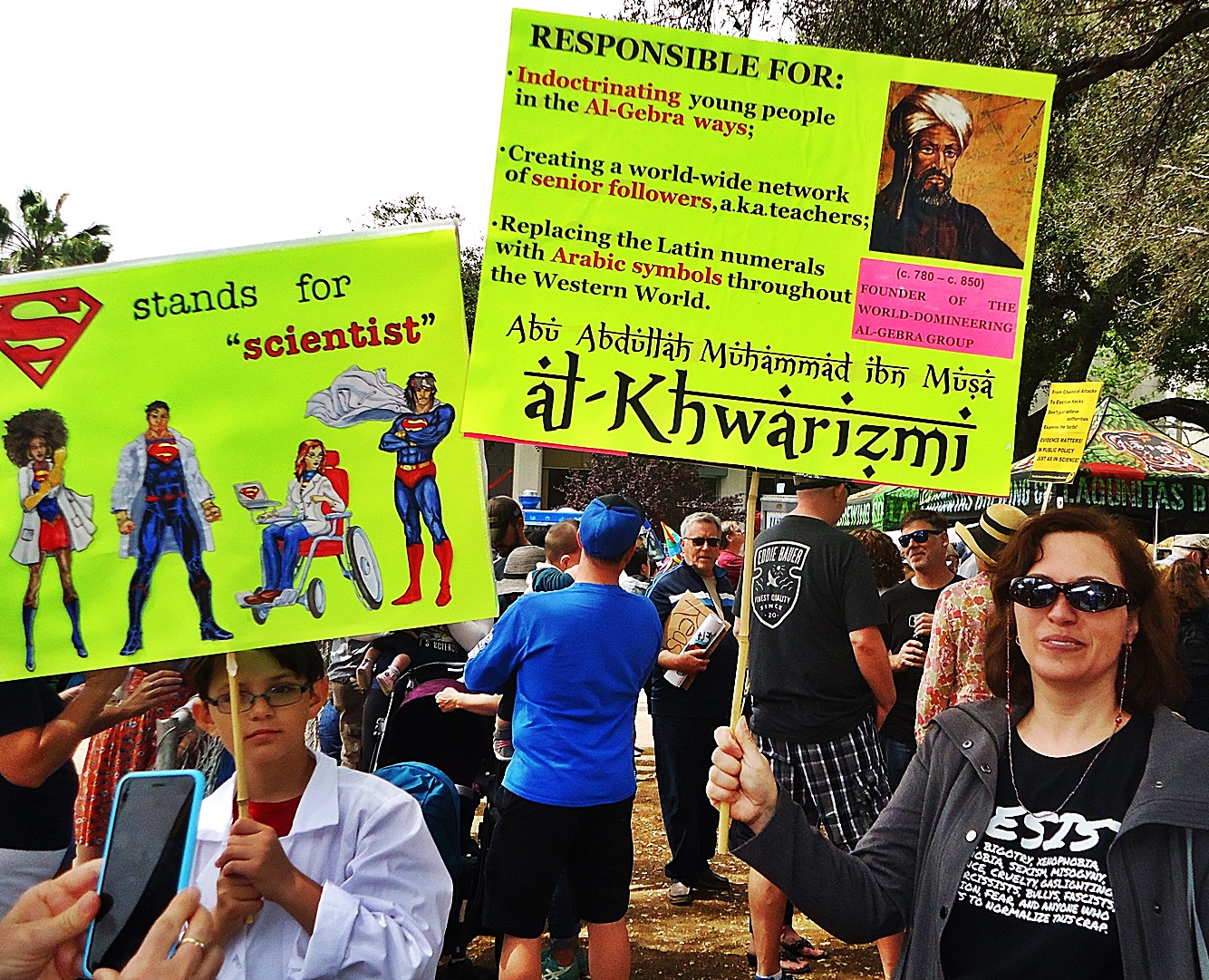
The math-themed signs were especially fascinating. Charles, a biophysics PhD from UCSF wanted everyone to know why the irrational number Pi matters: “3.14159 makes everything just so fine!” Crystal’s message was simple with profound implications: “I love Math.” But the most incisive message came from Dora and her 6th-grader son, Adrian who had designed posters praising the contributions of 8th-century mathematician al-Khwarizmi, considered the father of algebra. Married to an American, Dora is a Bulgarian who was praising a Muslim mathematician from olden times! Only in immigrant-rich America was this possible.


Tracy Van Houten, a rocket scientist at NASA’s Jet Propulsion Laboratory (JPL), also extolled the value of STEM, particularly for girls and minorities. “Scientists are underrepresented in our government,” she said. Of the 535 members of the Two Houses of Congress, only 11 are scientists. “That’s less than 2 percent! We have to not only protect science but also scientists,” she said. “We will prevail because Trump fears facts and facts are on our side.” Houten had to recently make a wrenching decision. “I was exploring the universe but gravity pulled me back to earth. I loved my job at the JPL,” she said, “but I felt the fierce urgency of now, this calling to rescue our country from partisan muck and science-deniers and put science back at the center of decision-making.” After Trump’s election, she quit her JPL job and is now running to represent the 34th Congressional District of California in the Congress.

The rally was billed not as a protest but as a march to affirm the value of science and to demand that the Trump administration use facts rather than polarizing and paralyzing ideologies to frame policies. We have a president who ignores evidence in favor of opinion, who has picked, as administrator of the Environmental Protection Agency (EPA), a man who denies that carbon dioxide is a primary source of global warming. Trump’s proposed budget would cut $12.6 billion from the Department of Health and Human Services, including $5.8 billion from the National Institute of Health alone, with potentially disastrous consequences for medical research. His ban on immigration threatens our scientific institutions like MIT, a significant percentage of whose faculty is foreign-born.


What will it mean for America if Trump has his way? Byron, a marine biologist, shared his perspective with me at the rally. “I don’t believe Trump will succeed. He will probably be neutered by division within his own party. His policies are likely to grind to a halt. But we can never be sure, so we have to keep up the momentum.”

The most moving moment at the rally came when I ran into 14-year-old Justin, a sophomore at the local Bellarmine College Preparatory. Justin suffers from Wilson’s disease, a rare inherited disorder caused by the mutation of a certain type of gene that leads to liver inflammation and reduced kidney function. “If it were not for drugs like syprine developed by scientists at 
Wilson’s Disease Association
, I wouldn’t be here. I owe my life to medical science.”