“I
had three chairs in my house; one for solitude, two for friendship, three for
society.”
Ever
since I read Walden over two decades
ago, I sometimes dreamed that I was transported back in time by a century and a
half to sit on that second chair one evening and have some heart-to-heart with
Henry David Thoreau.
“Do
you think I am leading a life of quiet desperation?” I might begin. Or perhaps
something lighter: “How are those beans coming along?” Or maybe inquire after
the health of his friend and mentor Ralph Waldo Emerson. How about the fate of
farmers mortgaging their souls to the devil, that is, to bankers, for the false
privilege of “owning” their homes?
There
would be much to talk about as the moon rose over the pines and its reflection
gave the Walden Pond an ethereal glow.
I
found the possibility of dialogue across time elusive, so this summer – August
2017 - I decided to do the next best thing. I flew from San Jose to Boston with
only one goal in mind, to see Walden Pond and feel Thoreau’s presence.

I
boarded a Commuter Rail from Porter Square in the city of Monmouth in
Massachusetts for Concord, the fabled town where Thoreau was born and in which
he spent a significant part of his life reflecting on the human inclination for
both savagery and nobility.
The
train journey took me through the lush summer vegetation typical of summer in
the Eastern United States. The green, a shade fresher than the green in Western
U.S., reminded me of the green in Bangladesh where I was born.
After
about an hour, I found myself in Concord. I looked out from the station and
tried to imagine what Thoreau might have seen and felt. Oh, well, there was Starbucks as well as several auto workshops, a general store, an optometry shop, a bank.


I
began the walk from Concord to Walden Pond, a distance of about a mile and a
half. Thoreau would walk this path to and from his cabin for an evening meal at
the home of his mother and brother and keep up with current events. He lived in
the cabin for 2 years, 2 months 2 days, from July 4, 1845 to September 6, 1847.
How many miles did he walk in all? Thousands. No wonder he looks so fit in the
only two photographs we have of him.


The
walk took me by immaculate lawns and quaint homes with ancient trees spreading
their ample shadows across grass and streets. It made the hot trek tolerable. Reminders
of Thoreau were everywhere, from the Thoreau streets and lanes to markers
pointing out where slaves hid a few years before the Civil War began, and some
of whom Thoreau helped escape to Canada through the Underground Railroad.

The
neighborhood was lily-white, so I was heartened to see a sign on a lawn that
said “Black Lives Matter.” Thoreau, among the original abolitionists, would
have smiled.
And
then suddenly I was on hallowed ground. I was at the bank of the Walden Pond.
Through the trees I could see the whole pond and its graceful finite shoreline enclosing infinite stories and memories.
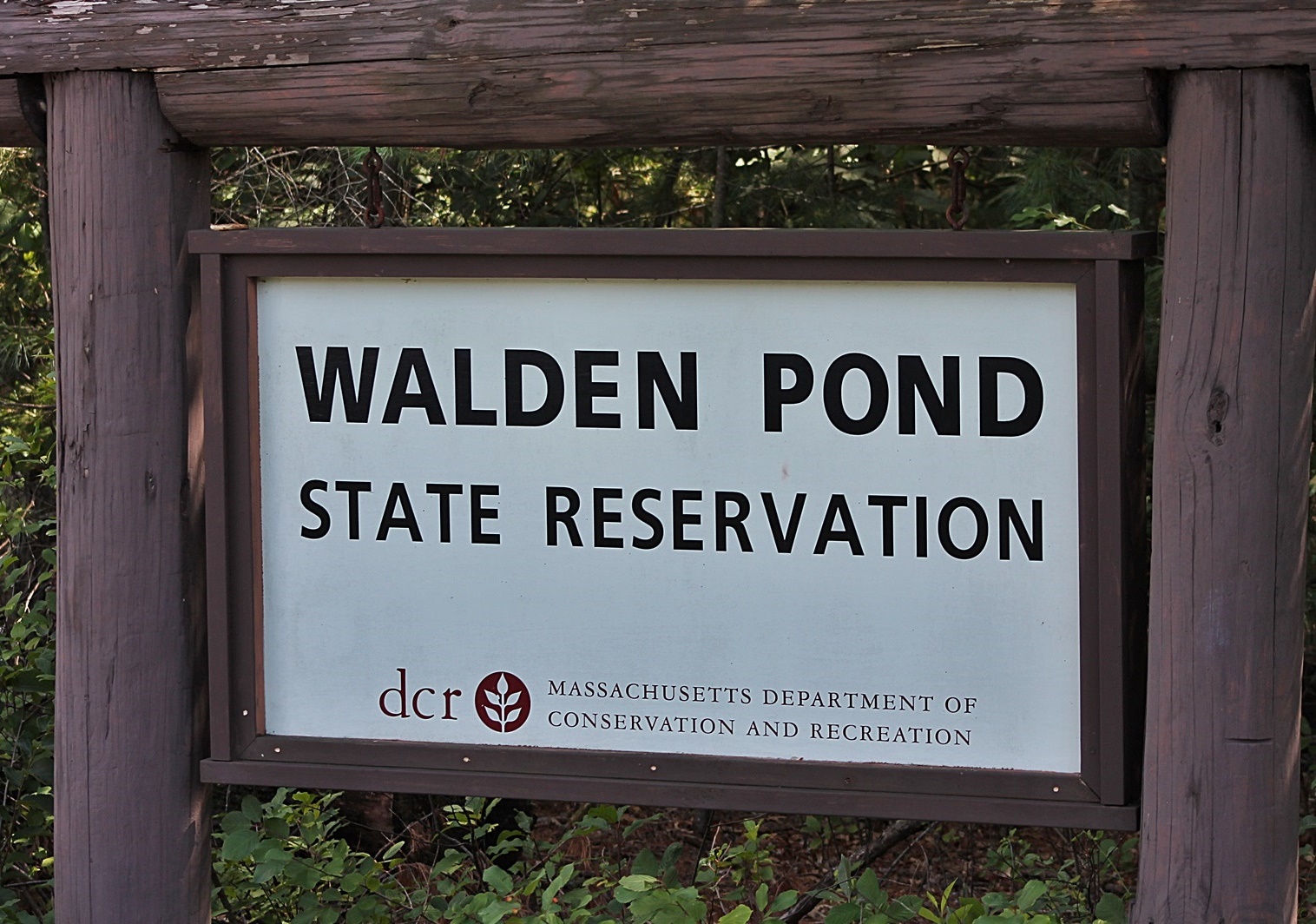
Walden
Pond was not so much a pond as it was a poem, a magical, mathematical pi rather
than a mere positive integer. People of all ages were sunbathing and swimming,
about two hundred of them, with lifeguards sounding out solemn instructions
from their high perch from time to time.


I
swam in the waters of the Walden Pond. Opened my eyes underwater after a few
laps and found the water as green as the vegetation around. A snapping turtle came
by to check out the humans and unimpressed, turned back and disappeared in the dark
deep waters. The water seemed cold at places and warm at others. Two
enterprising tourists were rowing on a canoe, going further than any swimmer
dared to venture.
In the winter of 1846, after the pond froze solid so that he could walk on it, Thoreau began to survey the pond. The instruments were unwieldy and heavy but Thoreau was undeterred. The "angle intersection survey" included the pond's perimeter, almost 2,900 feet. As described in the brilliant biography of "Henry David Thoreau, a Life" by Laura Dassow Walls, "with ax and ice chisel, he cut well over a hundred individual holes through the ice to lower the plumb line into the water ... Thoreau used the tools of science and engineering to create a remarkable work of art, a working survey that accurately mapped Walden Pond to the inch: length, breadth and depth ... it was 102 feet at the deepest point ..." This is how Thoreau summarized his work: "The line of greatest breadth intersects the line of greatest length at the point of greatest depth." The line is remarkable for the symbolism it contains for truth and purpose and life. In the incomparable prose of Thoreau: "It is the heart in man - It is the sun in the system ... Draw lines through the length & breadth of the aggregate of a man's particular daily experiences and volumes of life into his coves and inlets - and where they intersect will be the height or depth of his character."
In the winter of 1846, after the pond froze solid so that he could walk on it, Thoreau began to survey the pond. The instruments were unwieldy and heavy but Thoreau was undeterred. The "angle intersection survey" included the pond's perimeter, almost 2,900 feet. As described in the brilliant biography of "Henry David Thoreau, a Life" by Laura Dassow Walls, "with ax and ice chisel, he cut well over a hundred individual holes through the ice to lower the plumb line into the water ... Thoreau used the tools of science and engineering to create a remarkable work of art, a working survey that accurately mapped Walden Pond to the inch: length, breadth and depth ... it was 102 feet at the deepest point ..." This is how Thoreau summarized his work: "The line of greatest breadth intersects the line of greatest length at the point of greatest depth." The line is remarkable for the symbolism it contains for truth and purpose and life. In the incomparable prose of Thoreau: "It is the heart in man - It is the sun in the system ... Draw lines through the length & breadth of the aggregate of a man's particular daily experiences and volumes of life into his coves and inlets - and where they intersect will be the height or depth of his character."

After
swimming to my heart’s content, went to check out the Thoreau Center, selling
all things Thoreau: books, pictures, mugs, candies, maple syrup, posters. Next
to the souvenir shop was the replica of Thoreau’s cabin – a 10’ x 15’ house
with a single bed and a large window that looked out on the Walden Woods - and a
statue.

An
array of solar panels brought dignity to the parking lot. Sight of the sun’s
energy being harnessed would undoubtedly have pleased the Bard of Walden.
Thoreau wanted to live deliberately, that is, to live honestly with the full
awareness of the consequences of his actions. For this original, singular act
of courage, defiance and integrity, we remember him to this day with gratitude
and humility. He pointed us all toward a better way, that a person is indeed
“rich in proportion the number of things he can afford to let alone.”


On
the walk back from Walden to the town, that is, Concord, I thought of the events roiling America
these days. Donald Trump has emboldened racists and hate-spinners, turning America the Beautiful into America the Ugly. Thoreau would have walked
the 550 miles from Concord, Massachusetts to Charlottesville, Virginia, to
oppose the neo-Nazis, the Supremacists and the KKKs defiling the American
ideal. On July 23, 1846, He spent a night in jail in Concord for refusing to
pay a poll tax, fearing that the money could be used to pay for the
Mexican-American War he opposed. How gladly he would have spent nights, if not
years, in a jail if that’s what it took to free American from the shackles of
the hate-mongers and the internal terrorists on the rise in Trump’s America!
“What
is the use of a house if you haven’t got a tolerable planet to put it on?”
asked a prescient Thoreau. Global warming is the undeniable reliability of our
times but Thoreau saw it coming way before anyone else. He saw it but we don’t for
one simple fact: We choose not to live deliberately. That includes both the
affirmers and the deniers of global warming.

Raise
your hand if you think of yourself as a modern-day Thoreau, if you can live
deliberately as Thoreau did, even if only for a year in the wilderness by summoning
the willpower to resist the digital seduction, if you can fight for justice and
equality even while raising beans and being nourished by solitude.
What,
no hands? None at all?


