Saturday, May 27, 2017

Ramadan in a World Gone Crazy

You can also read the article here.

Evergreen Islamic Center, San Jose, CA

Today, Saturday, May 27, 2017, is the first day of Ramadan, the Muslim month of fasting, one of the five pillars of Islam. For Muslims in the Northern Hemisphere, the 30-day period is marked by anywhere from 14 to 16 hours of fasting, during which the throat gets parched and the stomach complains as adherents seek to strengthen their acquaintance with the Divine. 

Because the Islamic calendar, like the Jewish calendar, is based on lunar months, Ramadan advances through the seasons by about 11 days every year. So while Muslims in places like Australia will fast several hours less than us, we will switch times in years to come.

For the more than 3 million Muslims in America, Ramadan this year will be different in one particular way: We will be thinking more deeply about the fate of our country and its direction.

During the presidential campaign, then candidate Trump made no bones about maligning Islam and Muslims. “We have a problem in this country; it’s called Muslims,” he said at a 2015 town hall in New Hampshire. “I think Islam hates us,” he said at another time to the media.

He repeatedly promised to close mosques and create a Muslim registry in America if elected. Within a week of becoming president, he signed an executive order blocking Syrian refugees and travelers from seven predominantly Muslim countries from entering the United States, orders that, for now, remain blocked by the judiciary.

Given the history of his inflammatory rhetoric, I was curious to hear what Trump would say in Saudi Arabia, the birthplace of Islam and the first stop of an overseas tour that also took the president to Israel and the Vatican.

In a speech to more than 50 Arab and Muslim nations and their leaders, Trump asked Muslims to “purge the foot soldiers of evil” from their societies. “This is not a battle between different faiths, different sects, or different civilizations,” he observed. “This is a battle between Good and Evil … We are not here to lecture. We are not here to tell other people how to live, what to do, who to be, or how to worship. Instead, we are here to offer partnership — based on shared interests and values.”

This was in the spirit of Ramadan, I thought. I nodded in agreement (because that’s what Muslims like me have been saying all along).

But, then, action speaks louder than words! This is what Trump said in a meeting with the Emir of Qatar before the speech: "One of the things we will discuss is the purchase of lots of beautiful military equipment because nobody makes it like the United States."

During his stay, Saudi Arabia reportedly signed an agreement to buy “beautiful” American arms worth $110 billion, arms that is likely go toward the civil war in Yemen, a conflict that has yielded untold suffering and allegations of potential war crimes that could ensnare the United States alongside Riyadh. It also threatens to deepen the conflict between Saudi Arabia and Iran, between Sunni and Shia, making the Middle East even more volatile.

Bu violence has already erupted. A British Muslim of Libyan descent blew himself up with the sole intention of killing children at a concert in Manchester, killing 22 people, including an eight-year-old. In Egypt, extremist Muslim militants forced Coptic Christian pilgrims from a caravan of buses and killed 28. And in Portland, Oregon, a few hours before Ramadan was to commence, a white supremacist ranting against two Muslim women wearing Hijab on a public bus attacked three good Samaritans who came to their defense, and killed two of them.


It doesn’t look good! The sanctity of Ramadan, for Muslims a month of reflection, charity, restraint, self-discipline and compassion, is threatened by extremists everywhere.

Muslims are required to abstain not only from food and drink in this month but also from such vices as anger, impatience, or arrogance. The food part is relatively easy; it is the cleansing of the heart that is harder, particularly in these troubled times.

And while there is no estimate of what percentage of Muslim adults fasts - because fasting is considered a personal pledge between a believer and God – what is undeniable is that mosque attendance goes up dramatically during Ramadan, its social aspect most evident at ‘Iftar’ (Arabic for ‘breaking the fast’) just after sunset.

At San Jose’s Evergreen Islamic Center, we invite neighbors, co-workers, local politicians, police officers and anyone curious about our faith, to our weekend Iftars. Polls show that most Americans who harbor negative opinions about Muslims have never met one. If people can break bread together, we expect hate and enmity to recede. And it indeed does, based on what we have experienced, despite the occasional hate mail and taunts of “go back home.”

Many of the employers I have encountered, moreover, are aware of the demands Ramadan makes on believers and are sensitive to the needs of their Muslim employees. By the time we complete the special nightly prayers of Ramadan called ‘Taraweeh’, for instance, it is often past midnight. That means that many of us have to do with no more than 4-5 hours of sleep per night during workdays. If you find your Muslim colleagues sleepy or slow during working hours in Ramadan, you will perhaps know why.

Indeed, I have found nothing but empathy from colleagues and co-workers. When I worked in the tech industry, my co-workers avoided eating in my presence and gave me space to offer my afternoon prayers. It’s the same in the college where I now teach, where students sometimes ask me to slow down and conserve my energy while I am trying to explain a difficult concept in, say, algebra.

Ramadan is the believer’s gateway to the ineffable and the transcendent, when Muslims make an effort to pay more attention to the little things around us (which often turn out to be the big things), smile from the heart at friends and strangers, make more charitable donations.

So I find myself focusing this year on Ramadan’s message of hope, its rejection of despair, and the generosity of the average American. What keeps me awake is knowing where violence may erupt and who will fall victim to the nihilism of psychopaths. We will pray and be alert, to the extent that it is possible, so that no one who claims to be a Muslim can give Ramadan a black eye by engaging in violence and killing innocents.

Thursday, May 18, 2017

DACA Students Trapped Between Fear and Anger

His parents brought Lopez from Mexico to the U.S. in 2007 when he was 15 years old. They had no immigration papers but managed to find their way to Santa Barbara. “My parents worked as hired laborers but we still had a fairly good life,” said Lopez, currently a student in San Jose who hopes to graduate this Spring with double majors in International Business Administration and Finance and transfer to San Francisco State U in Fall. “But now with Trump as president, everything is up in the air. I cannot walk down the street without looking back to see if ICE agents are about to grab me. They know where I live, where I work.”

How does ICE knows that?

“I am a DACA student (note: DACA stands for “Deferred Action for Childhood Arrivals,” 
a program started by President Obama in 2012 that protects some undocumented youths from deportation)
 so I can study and work without any problem. But I have to renew my registration every 2 years. That’s when I have to give them my address, where I study and work. They have me in their database.”

But if you are legally permitted to study and work, why the stress?

“The fear is always there. I read stories of ICE agents picking up undocumented Mexicans. With Trump in power these guys have become aggressive. My parents returned to Mexico several years ago. I thought of going back myself but they told me not to because life has become very violent in their village deep in Southern Mexico. They said I wouldn’t last a day.”

I was talking with several DACA students in San Jose whose lives had taken a turn for the worse ever since president Trump took office.

“It’s the uncertainty and the stress and the fear that’s killing me,” said Maria, who will be graduating in a year and hopes to become a dentist. “I come from a mixed family. I have two sisters who were born here, so they are citizens. But my parents are undocumented. I am undocumented. I don’t know what will happen if my parents are deported. Who will look after my little sisters? My family can be torn apart any minute.”

Have you contacted city officials, the mayor’s office?

“Yes, many of us did. We prepared a list of questions like ‘How is San Jose a sanctuary city? What does it mean? What kind of assistance can we get in these safe places? How can you ensure that DACA students can safely exit and return to USA in case of emergencies? If a parent is detained, can the city do anything for the children?’ and so on. The Mayor’s office was friendly and supportive but the best they can do now is to fund some existing non-profits like SIREN and PACT to help us. It will take too long for the city to create its own agency to help us.”


What about churches and synagogues?

“We have heard that many churches and synagogues in the Bay Area have become sanctuaries but we haven’t contacted them yet,” said Valdez, who will graduate next summer and has applied to several medical schools. “Right now we are being cautious. Even though we are DACA, our status can be revoked anytime for any ridiculous reason. It has happened to people I know. The fear is constant. But I will tell you something, I am fed up with fear. I don’t believe in hiding. Why should I have to hide or act afraid? I work hard. I contribute to America like other Americans. I am a good person. The way Trump talks, it’s as if any Mexican or American of Mexican background is a criminal.”


So how do we move forward?

“There is a lack of empathy in this country,” said Valdez. “Most Americans who voted for Trump in the Midwest don’t care about immigration or deportation or the Muslim ban. They want good jobs, good salary, good vacation. They want good healthcare. In fact, it’s only healthcare that will either make it or break it for them with Trump. If Trump fails them in healthcare, they will go against him.  In the meantime, we need to talk with them with respect, with empathy. But they need to talk us too! They complain about jobs Mexicans and others are taking away but they don’t want the dirty jobs we do and our parents do. They don’t want to work in restaurants, in the fields, as cleaners, as laborers. There’s a gap in communication. We need to fill that gap. We need to walk in their shoes and they need to walk in ours. How can we know one another if there’s no empathy?”

Have you faced discrimination at work or when applying for jobs?

“We can’t apply for any federal job, like the post office or the IRS,” said Rivera, who has been with a high-tech company for a year in the marketing department. “Our undocumented status doesn’t allow us. Even in the private sector, we face too much hassle from some managers. If they know we are undocumented, there’s immediately a bias. It’s not true for all managers but definitely true for some. It’s difficult to explain how we know bias. We just know it in our guts. Not all hiring managers are like that. I have a great manager now and I am happy. But it’s a fact, my manager cannot protect me from ICE.”

Do you think America will come out stronger as a nation once this current dark period passes?

Lucia isn’t sure.

“I am not that optimistic. Look at American history. There was slavery, segregation, civil rights movement and all that but racism flourishes, more under Trump than any time in my memory. There were Internment camps. I heard some people openly talking of Muslim registry. But we are told in history books that these are only little bumps, nothing to worry about. We hide them under the rug and say, ‘America, Not Guilty!’ It may look like Trump is losing but unless we change and come together, unless we put law above politics, he may be here for a long time.”


Tuesday, May 16, 2017

President Trump Must Step Down, Or Be Impeached

The firing of FBI director James Comey by president Trump on 9th May unleashed a cacophony of foul play claims redolent of the Watergate scandal that forced Richard Nixon to resign in 1974, almost 19 months after he was sworn in to his second term. The combination of possible obstruction of justice, hidden tapes and veiled threats in the Comey firing makes the comparison to Watergate compelling.

But all that has been overtaken by what has happened within a week of Comey’s firing. We learned from Washington Post on 15th May that Trump disclosed highly classified information to Russian foreign minister Sergei Lavrov and Russian ambassador Sergei Kislyak in the Oval Office a day after he let Comey go. 

Then, on 16th May (today), New York Times reported that during their February 14th meeting at the White House, Trump asked Comey to drop the Michael Flynn inquiry about possible Russian collusion in the presidential election last year. “He is a good guy,” Trump said of Flynn. "I hope you can let this go."

The president was alone with the FBI Director after he asked attorney General Sessions and VP Pence to leave the room.

John McCain, the senior Republican Senator from Arizona, said about the two latest bombshells: “Trump scandals are reaching Watergate size and scale.”

Talk of impeachment is in the air, along with the demand that Republican lawmakers show some spine and put country above party. America is at a crossroads because the 45th president, by all indications, has engaged in obstruction of justice, an impeachable offense. 

The moment of truth is here. There is no turning back.

A comparison with Watergate and the current Congress offers perspective.

In the 93rd Congress (1973-1975) during Nixon’s second term, Democrats held both the Houses, with 242 Democrats to 193 Republicans in Congress, and 56 Democrats to 44 Republicans in the Senate. The House Judiciary Committee consisted of 38 members, 21 Democrats to 17 Republicans. By law, a simple majority is required for each article of a resolution to pass, including impeachment.

Six Republican Congressmen switched sides to join all 21 Democrats in the judiciary committee to recommend that Nixon be impeached through a Senate trial. The article of impeachment was adopted 27 to 11 in that historic vote, although Nixon quit before suffering through the ignominy.

In the 115th Congress (2017-2018), the numbers have flipped. There are 238 Republicans to 193 Democrats (with 4 vacancies) in Congress and 52 Republicans to 46 Democrats, with 2 Independents, in the Senate. The current House Judiciary Committee comprises 23 Republicans and 17 Democrats.

What is the possibility that history will repeat itself in 2017 or 2018? 

The twin bombshells - Trump spilling secrets to the Russians and asking Comey to drop the Flynn investigation - have changed the equation for the president. The combination of arrogance and ignorance, the 'damn care' attitude that has endeared him to his blind supporters, the impunity with which he flouts decency and the Rule of Law, has exceeded all bounds. The 'i' word is being sued more and more, and not just by Democrats like Maxine Waters of California, for whom the case for impeachment is clear as daylight.

Will the democrats have to wait until the midterm elections in 2018 to gain seats in the House to turn the tide? 

Not after the twin shockers. The ancient saying, “The wheels of justice grind slowly but exceedingly fine,” needs updating. When the damn breaks, there is nothing slow about it.

A national character test is upon us.

We like to believe that in America no one is above the law. To underscore our faith in that guiding principle, we add, “including the president of the United States.” It implies that if or when the moment of truth arrives, our lawmakers will put country before party.

Is this still true 241 years after the founding of our nation?

Consider what made some Republicans switch party allegiance during the Watergate hearings.

Caldwell Butler of Virginia explained it this way: “If we fail to impeach, we will have condoned and left unpunished a course of conduct totally inconsistent with the reasonable expectations of the American people …”

Lawrence Hogan, from Maryland and a former FBI agent, reasoned thus: “Richard M. Nixon has, beyond a reasonable doubt, committed impeachable offenses in an extended and extensive conspiracy to obstruct justice … The evidence convinces me that my President has lied repeatedly, deceiving public officials and the American people. Instead of cooperating with prosecutors and investigators … he concealed and covered up evidence.”

But it was Peter Rodino, the Democratic New Jersey Congressman and chairman of the House Judiciary Committee, who summed it up best for the nation: “I have been guided by the principle that the law must deal fairly with every man. For me this is the oldest principle of democracy. It is this simple but great principle which enables man to live justly and in decency in a free society … Our judgment is not concerned with an individual but with a system of constitutional government … Let us leave the constitution as unimpaired for our children as our predecessors left it to us.”

Thursday, May 04, 2017

Unintended Consequences of Hate

You can also read the article here.

SAN JOSE, Calif. -- The pickup truck was following her. Dr. Sarah felt nervous but tried to convince herself it was just her imagination. He couldn’t possible know she was a Muslim, particularly since she was not wearing the optional hijab, the traditional Islamic head-cover to indicate modesty.

She pulled into the parking lot and got out of her car. The pickup slowed. As she crossed the street to get to her office, the driver, a middle-aged white man, rolled down the window and screamed at her: “Go back home!”

The heat of the man’s hate felt as if it were burning a hole in the back of her head. She ran to the safety of her hospital.

Dr. Sarah was born in Chicago to Muslim parents. After receiving a doctorate in psychology, she began working at a hospital in Silicon Valley in the pain management department as a psychologist, a job in which she has flourished for over a decade. When she reported the incident to her concerned supervisor, she advised her not to drive alone for a few weeks.

A week earlier, an engineer of Asian background, an American citizen, was confronted in the parking lot of a grocery store in San Jose by a driver who screamed: “Go back to where you came from.”

For many residents, the sprouting of bigotry in what is the heart of Silicon Valley, with a diversity of culture, religion and ethnicity rare in the world, is shocking.


“Before, I used to call my friends and relatives in India to ask if they were okay,” said Assemblyman Ash Kalra during a rally organized in response to the growing climate of fear following the election. “Now they call me to inquire if I am safe in Trump’s America!”

Trump has indeed loosened the shackles of bigotry among his supporters, emboldening them to threaten those who don’t look like them, and to hurl insults like, “Go back to where you came from!”

The Council on American-Islamic Relations (CAIR) has reported harassment and threats targeting Muslim women and children in Minnesota, North Carolina, New York and California in just the past two weeks alone. 

According to the Southern Poverty Law Center, there were 867 hate incidents in the ten days after Trump’s win in November. The advocacy group South Asians Leading Together (SAALT) put out a report in January that documented 207 hate incidents targeting South Asians, Muslims and Middle Easterners in 2016. The report noted the climate resembled the months following the 9/11 attacks, and attributed the spike in hate to campaign rhetoric during the 2016 race.

Here in San Jose, police documented four cases
 of crimes targeting Muslims in 2016. There were no cases prior in the years going back to 2011. Experts say the numbers are misleading, and that because victims are often reluctant to come forward, due to cultural or linguistic barriers, or because they are scared, the figures could be higher. 

One of those cases involved the Evergreen Islamic Center, where a letter was received just prior to the Thanksgiving holiday that read, in part: “There’s a new sheriff in town – President Donald Trump. He is going to cleanse America and make it shine again. And he’s going to start with you Muslims.” The letter went on to make reference to Nazi Germany, saying Trump would “do to you Muslims what Hitler did to the Jews.”


Still, despite the rising tide of Islamophobia, something remarkable began to happen among members of the local Muslim community in the days and weeks following Trump’s win. Having learned in the aftermath of 9/11 that a culture of shame and silence only promoted the politics of fear, area Muslims instead started forging bonds with community residents at a grass-roots level.

Several members of Evergreen (myself included) joined Indivisible East San Jose, 
one of nearly 6,000 Indivisible Groups that sprang up across the nation as a response and resistance to Trump’s presidency.

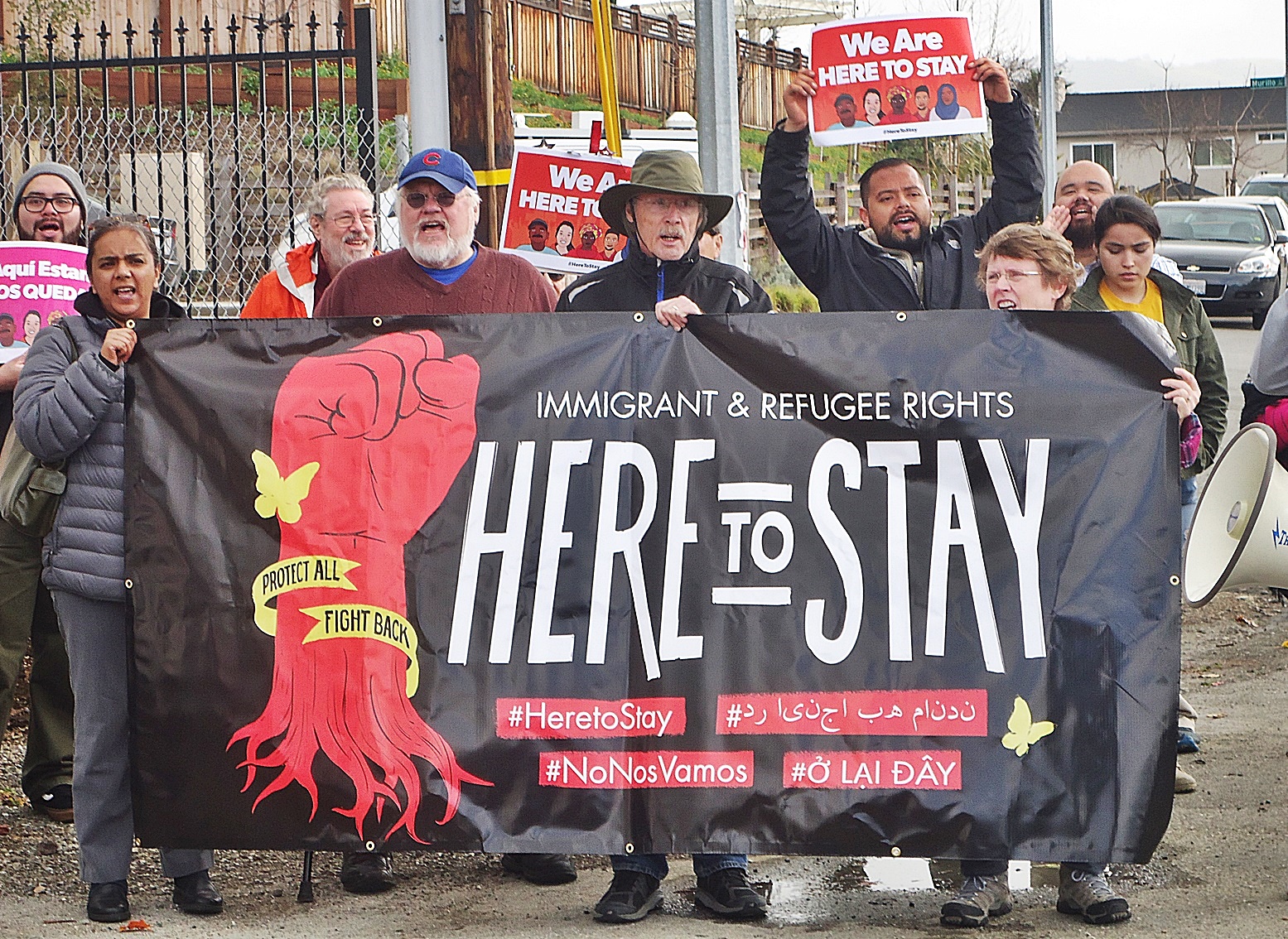
Meeting once every month, members knock on doors in San Jose’s depressed areas, informing undocumented workers, for example, of their rights if ICE shows up and the availability of free legal help. A few families in dire straits have been escorted to sanctuaries in synagogues and churches. 


On a recent Sunday afternoon, Evergreen teamed up with local Christians and Jews as members of Abrahamic Alliance at a church to prepare meals for the homeless and serve them across town at City Team San Jose, an organization that helps people struggling with poverty, homelessness and addiction. For many of us, this was our first experience with a soup kitchen. We were shocked to find that in one of the most prosperous areas in the world, there were people for whom a decent meal and a bed to sleep on were luxuries often beyond reach. We realized that more than mosques, we needed to build more soup kitchens and shelters for abused women, including Muslim women.


As remarkable is the growing outreach and solidarity extended to area Muslims from other immigrant
 communities. There have been several marches staged to commemorate the Japanese internment and to draw connections between that dark period in U.S. history and its echo against Muslims in Trump’s time. Meetings were held with Internment survivors who spoke of the importance of resistance.

Then there are the acts of individual kindness.

“Just think about it,” said Peggy, who drove an hour from the city of Santa Cruz with several friends in a show of solidarity with Evergreen following the recent threats. “Would we have even met if it were not for Trump? No! This is the silver lining in the dark cloud that hangs over our nation now.”

For local Muslims, the bridges now being formed in the era of Trump are a case of serendipity, the unintended but cathartic consequences of hate.

Saturday, April 29, 2017

Affirming Science in Silicon Valley on Earth Day 2017

You can also read the article here.

Nobel Laureate Dr. William Moerner addressing the huge gathering
at the March for Science rally in Downtown San Jose on April 22. 

SAN JOSE, Calif. -- “I was 26 years old when my mother died of breast-cancer,” said Dr. William Moerner, a professor at Stanford and winner of the 2014 Nobel Prize in chemistry ‘for the development of super-resolved fluorescence microscopy.’ He marveled at how far the treatment of breast cancer had come, thanks to science, compared to the painful and crude treatment his mother had to endure in the ‘70s.

Moerner was one of several speakers at the “March for Science” rally in downtown San Jose at the Plaza de Cesar Chavez on Earth Day, April 22. “Today we carry supercomputers in our pockets,” he said. “We are harvesting energy from the sun without damaging nature.” Addressing climate-change deniers, he said, “Science is true whether or not you believe it,” drawing vigorous applause from his listeners who had come together to protest the policies of the ‘Denier-in-Chief’ in the White House. As to what each of us can do, the Nobel-laureate suggested that we learn how to detect fake science, how to explain the value of science to others, and to kindle our curiosity by figuring out how things work. “It’s even fun!” said Moerner, someone who should know.


About 10,000 of us – scientists, artists, students, teachers, mothers, fathers, daughters, sons and concerned citizens of every stripe and persuasion – had gathered in San Jose to affirm our faith in the importance of science in shaping our lives and in keeping our planet healthy. Similar rallies had taken place in all 50 states and in more than 500 cities around the world in seven continents.

I looked around. The posters, many made of recycled papers as befitting an Earth Day celebration, were pithy, thought-provoking, forceful, factual and witty in a nerdy way.


“The oceans are rising and so are we.”

“Evidence-based policy, not policy-based evidence, a.k.a. alternative facts.”

“No Science, Art or Humanities. No Freedom.”

“Super callow. Fragile ego. Trump you are atrocious."

“Without science you wouldn’t be taking that picture.”

“The ‘upside’ of climate change: Mara-a-Lago under water.”

“Atoms make up everything. So does he.”

The combination of outrage and passion – outrage at Trump’s destructive policies and passion for the health of the earth (“There is no planet B”) – was ineffably inspiring.

Jennifer had a ‘scientific’ message for people: “Think like a proton. Be positive.” Francesca had bedecked herself as Miss Liberty: “May we always have the liberty to seek the Truth.” Arthur used a metaphor from chemistry: “If you’re not a part of the solution, you‘re part of the precipitation.” Third-grader Eli, standing next to his approving father, was clear about his career: “I want to be president an engineer when I grow up.”

There were more women than men, debunking the myth that girls are not into science. 5-year-old Sophia, perched on her mother’s shoulder, declared: “I love science.” A woman weaved her way through the crowd: “Back off, man! I’m a scientist!” Another woman warned of the danger of learning science from politicians and not from scientists like her. Dvina, a native of San Jose currently working as a medical researcher at the University of Munich in Germany, was using her vacation time to reinforce the theme of the rally: “Science not Silence.” The proud parents of 3-month-old Lucia had pinned this sign to her stroller: “Forget princess! I want to be a rocket scientist.”


Dr. Jose Cabrera, a chemistry professor at San Jose City College elicited roars of approval when he identified the critical role community colleges play in America’s educational system and his impassioned plea to young people to consider STEM (Science, Technology, Engineering, Math) fields as careers. (Disclaimer: Dr. Cabrera was my mentor at City College during my tenure process as a math faculty.) “We are seeing the spread of pseudo-science in our country,” he said. “We must distinguish between science and pseudo-science and learn to see the extraordinary in the seemingly ordinary.”


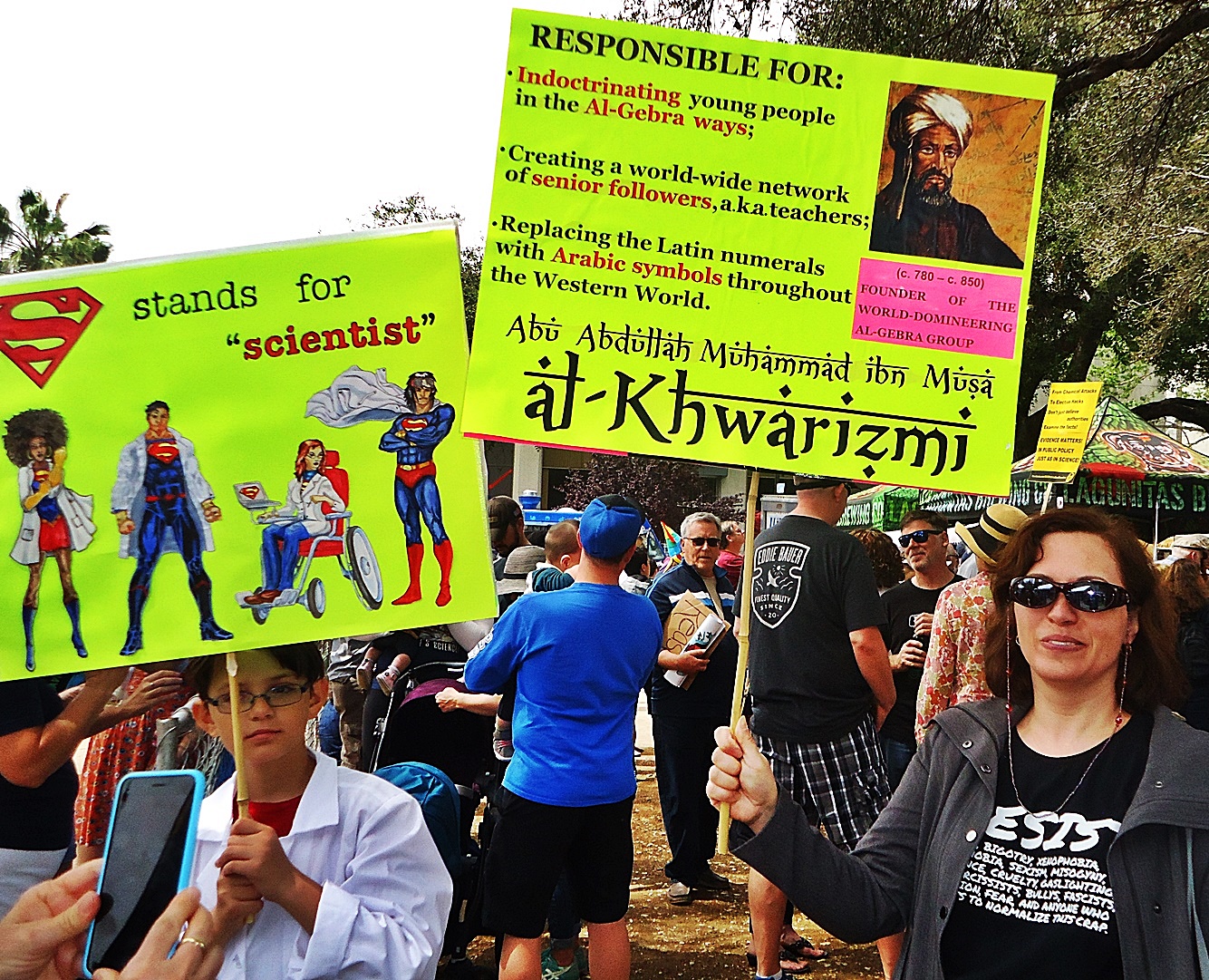
The math-themed signs were especially fascinating. Charles, a biophysics PhD from UCSF wanted everyone to know why the irrational number Pi matters: “3.14159 makes everything just so fine!” Crystal’s message was simple with profound implications: “I love Math.” But the most incisive message came from Dora and her 6th-grader son, Adrian who had designed posters praising the contributions of 8th-century mathematician al-Khwarizmi, considered the father of algebra. Married to an American, Dora is a Bulgarian who was praising a Muslim mathematician from olden times! Only in immigrant-rich America was this possible.


Tracy Van Houten, a rocket scientist at NASA’s Jet Propulsion Laboratory (JPL), also extolled the value of STEM, particularly for girls and minorities. “Scientists are underrepresented in our government,” she said. Of the 535 members of the Two Houses of Congress, only 11 are scientists. “That’s less than 2 percent! We have to not only protect science but also scientists,” she said. “We will prevail because Trump fears facts and facts are on our side.” Houten had to recently make a wrenching decision. “I was exploring the universe but gravity pulled me back to earth. I loved my job at the JPL,” she said, “but I felt the fierce urgency of now, this calling to rescue our country from partisan muck and science-deniers and put science back at the center of decision-making.” After Trump’s election, she quit her JPL job and is now running to represent the 34th Congressional District of California in the Congress.

The rally was billed not as a protest but as a march to affirm the value of science and to demand that the Trump administration use facts rather than polarizing and paralyzing ideologies to frame policies. We have a president who ignores evidence in favor of opinion, who has picked, as administrator of the Environmental Protection Agency (EPA), a man who denies that carbon dioxide is a primary source of global warming. Trump’s proposed budget would cut $12.6 billion from the Department of Health and Human Services, including $5.8 billion from the National Institute of Health alone, with potentially disastrous consequences for medical research. His ban on immigration threatens our scientific institutions like MIT, a significant percentage of whose faculty is foreign-born.


What will it mean for America if Trump has his way? Byron, a marine biologist, shared his perspective with me at the rally. “I don’t believe Trump will succeed. He will probably be neutered by division within his own party. His policies are likely to grind to a halt. But we can never be sure, so we have to keep up the momentum.”

The most moving moment at the rally came when I ran into 14-year-old Justin, a sophomore at the local Bellarmine College Preparatory. Justin suffers from Wilson’s disease, a rare inherited disorder caused by the mutation of a certain type of gene that leads to liver inflammation and reduced kidney function. “If it were not for drugs like syprine developed by scientists at 
Wilson’s Disease Association
, I wouldn’t be here. I owe my life to medical science.”


Friday, April 21, 2017

Lack of Tax Returns Puts Trump on Trial

“Where are you from?” I asked the couple who had greeted me with big smiles.

“From Sierra Nevada,” the wife replied.

When my eyes widened, the man said, “No, not the one in Spain. The one in California!”

We laughed.

Around us, in front of the City Hall in San Jose, people were gathering for the April 15 Tax March, part of the nationwide rally to demand that president Trump disclose his tax returns for transparency and accountability.

Vida and husband Bill, along with daughter Lauren, son-in-law Steve and 1-year-old granddaughter Lilian, had driven 170 miles from Arnold, a picturesque town in the high Sierra, to join the march.

“We have a moral obligation.” said Vida, “Trump must know he is accountable to the people of the United States.” She and Bill had come prepared with posters they were waving for passersby to see: “Trump can’t fool all the people any time” and “No Tax Reform until we see your Tax Returns for twenty years.”


By noon, our numbers had swelled to about 700. Cars whizzing by honked to indicate their approval as we filled the spring sky with resonant chanting:

“Hey hey, Ho, ho. Donald Trump has got to go!”
“No more secrets, no more lies. Show your taxes, show your ties!”

I looked around. The posters told the story as well as any storyteller could. Three generations of Turner family of San Jose held up posters that read “Wanted: Trump’s Taxes” and “Nevertheless, She persisted.” The Turners are the driving force behind “Indivisible East San Jose,”
 one of the 5983 Indivisible groups nationwide that had spontaneously been formed after Trump became the president.

Other signs included “Use Trump’s Taxes to pay for his wall! Do not use my taxes!” 

“7 trips to Mar-a-Lago but cuts to kids’ programs, EPA, Libraries. Shame!” 

“What are you afraid of? Treason?” 

“Real Men Show Their Taxes!” 

“Did You Lose Your Taxes Like You Lost the Popular Vote?” and so on.


One particularly creative San Josean put Trump’s tax fiasco in perspective by identifying the seven presidents before him who had released their tax returns with a check box next to their names but a big red X next to Trump’s. Lida, a naturalized American citizen from San Leandro, designed her own: “Manchurian Idiot.”


Shelly, a 66-year-old activist, spoke of her philosophy: “Peaceful resistance is the answer. Each one of us must care for the other. Trump doesn’t care. I have to do my part to show I don’t support his ideas.”


At the downtown Cesar Chavez Plaza that was our destination, the megaphone belonged to anyone with anything to share with the marchers. No politicians or celebrities or big names, just ordinary Americans expressing their concern about the direction the country was heading under Trump. “We have lost the thought war,” said a woman. “We did not vote, thinking it would be a cakewalk for Hillary. We have got to get the vote out, retake the Congress, the Senate and, of course, the White House.” Another speaker asked the rally to be vigilant about Republican gerrymandering. But mostly it was about the unacceptability of Trump holding himself above the law, about issuing executive orders that violated the fundamental values of America, and about lack of transparency in not disclosing his tax returns. “Before the election, Trump kept talking about Obama’s missing birth certificate,” said a young African-American. “What we want to know is why his tax returns are missing!”

The rally was not just about tax returns, it was about building a community and imbuing it with hope and purpose. The passion in the march was palpable. “I see people’s power in action,” said John standing next to me, clearly energized. “I will be a part of every march in San Jose, climate march, science march, any march that unites us so we can get Trump off White House as soon as possible. The future of our country is at stake!”

I stopped by the campus of San Jose State University (SJSU) that’s within walking distance of City Hall. I had taught at this university many years before but nostalgia was not the reason for my visit. I wanted to re-read the plaque honoring two of SJSU’s most famous student-athletes, Tommie Smith and John Carlos.


To refresh the reader’s memory, 200-meter sprinters Smith and Carlos represented the U.S. in the 1968 Olympics in Mexico City, Mexico. Smith won the gold medal and Carlos the bronze. At the podium during the award ceremony, Smith and Carlos bowed their heads and raised black-gloved fists during the playing of the Star-Spangled Banner to express their disillusionment with a nation that tolerated, and even encouraged, racism against African-Americans. Millions of Americans were outraged. They were vilified, suspended and received death threats but Smith and Carlos never relented, never apologized. "We were just human beings who saw a need to bring attention to the inequality in our country," Smith said years later.

37 years on, in October of 2005, Smith and Carlos were honored by their alma mater with statues capturing their iconic, unforgettable image at the Olympics podium. The plaque states that they were honored because they stood for “justice, dignity, equality and peace.”


I felt a shiver down my spine as I read those words. Here we were, almost half-a-century later, and our country is awash with what seems to be even more virulent forms of injustice, indignity, inequality and hostility than what Smith and Carlos saw and felt in 1968.

How could we have regressed so much? I wondered. What made it possible for someone like Donald Trump to become the president of the United States?
Karl Marx said, “History repeats itself, first as tragedy, second as farce.” Only a Donald Trump could have pulled off the unique feat of combining both tragedy and farce in his first 100 days in office.

Yet the Tax March I attended has given us hope that we can bring about the change we seek. As Candy Basso, a member of the Indivisible Blue Sisters said at the Chavez Plaza, “I never protested in my life until now. I was in the blue bubble. I want to thank Donald Trump for one thing. He has awakened us. The silent majority is silent no more.”