Showing posts with label chemistry. Show all posts

Wednesday, December 20, 2023

Raising the Level of Reading Comprehension of Students at Community Colleges

Emphasis on Student Learning Objectives (SLOs) and grades should not divert us, the math faculty at community colleges, from our main goal: a meaningful and quality education for our students. SLOs and evaluations are necessary but we need to recognize that other factors are also important. One such is reading comprehension, the ability of students to understand what they are reading, particularly word problems. While students can answer straightforward questions like “Let A and B be events with P(A) = 0.8, P(B) = 0.1 and P(B|A) = 0.2, Find P(A and B)” or solve quadratic equations like x2 – 7x + 11 = 0, they are sometimes unable to parse sentences in word problems to figure out what needs to be done, far less solve them. 

Yet it is word problems that help students connect with the real world, encourage them to think about relationships between numbers, and reveal interdisciplinary connections between mathematics and subjects such as English, physics, astronomy, chemistry, biology and environmental science.

Here is an example from statistics that illustrates how a lack of reading comprehension becomes a barrier for students to solve word problems.

Statistics (section 7.2, Elementary Statistics by Navidi and Monk): According to the National Health Statistics Reports, the heights of adult women in the United States are normally distributed with a mean of 64 inches and a standard deviation of 4 inches. If three women are selected at random, what is the probability that at least one of them is more than 68 inches tall?

The first difficulty students face is the phrase “At least 1”. The second is with the meaning and implication of the word “random.”

Students had learned one of the probability formulas in a previous section: “Probability (At Least 1) = 1 – Probability (None)”. They have no difficulty running “normalcdf” in their calculators to determine the probability when the parameters are explicitly given. However, connecting the formula and the idea of randomness and “normalcdf” to this problem seems beyond the capacity of most students. It comes down to a reading comprehension issue.

After carefully parsing the sentence “If three women are selected at random, what is the probability that at least one of them is more than 68 inches tall,” they slowly begin to make the connections. To ensure comprehension, I ask students to write complete sentences describing the steps they use to solve word problems such as this “if you want full credit.”

That last clause gets their attention.

This is a typical writing sample from approximately 60% of the students (the other 40% struggle to express themselves) who write complete sentences to describe the steps:

a) Find the probability that any one of the three randomly selected women is shorter than 68 inches by running (TI-84) normalcdf (0, 68, 64, 4) = 0.841. That is, the probability that a woman picked at random has a height between 0 and 68 inches is 0.841.
b) Since the three women are selected at random (no connection between them, that is, they are “independent” of each other), the probability that ALL three women are shorter than 68 inches is, by the multiplication law of probability,
P (A and B and C) = P (A) x P(B) x P(C) = (0.841)3 = 0.595.
c) Apply the “At Least 1” formula: Since the sum of all probabilities = 1, and since “At Least 1” includes all possibilities other than 0 or None, “At Least 1” and “None” include ALL possibilities between them. They are complements of each other. Therefore,
P(At Least 1) + P(None) = 1; P(At Least 1) = 1 – P(None)
Probability (At least One Woman taller than 68 inches) = 1 – 0.595 = 0.405

(Occasionally, a few students will go further and fill in more details. This is typical of what they write: To calculate P (At Least 1) directly requires the calculation of 7 different probabilities for this particular problem.
1. A is taller than 68 inches but not B and C  
OR

2. B is taller than 68 inches but not A and C  
OR
3. C is taller than 68 inches but not A and B  
OR

4. A and B are taller than 68 inches but not C  
OR

5. A and C are taller than 68 inches but not B  
OR
6. B and C are taller than 68 inches but not A  
OR

7. A, B and C are all taller than 68 inches

The only other option is
8. All of them (A, B, and C) are equal to or shorter than 68 inches, that is, NONE are taller than 68 inches.

The sum of all 8 probabilities = 1. So a) either I calculate the probabilities for options 1 through 7 individually and sum them, which is tedious and can lead to mistakes, or b) I do option 8 and subtract it from 1, which gives me the sum of probabilities for 1 through 7. It's easier to use option b, a neat trick!)

One or two students who take meticulous notes of what I emphasize in class will also add something like this:
“Even though entering actual heights between two boundaries gives the area under the bell curve, which is equivalent to the relevant probability, the calculator converts the heights into their corresponding z-scores ‘behind the scene.’ The area under the curve can be interpreted as probability only when the actual values, the heights in this case, are converted to their corresponding z-scores.”

I insist on complete sentences to explain the solutions to word problems because it becomes a test for students to see how well they understand the problems, that is, how good their reading comprehension is. Reading carefully clarifies their thinking, which, in turn, leads to clear writing. Reading and writing reinforce each other in a creative loop. Since language is the basis of thought, reading and writing well allow students to think well too. Students discover that this is true not just for English but also for math. 

I find it helpful to emphasize to students that they can often figure out solutions to hard problems as they go along. Many students, at least initially, have the mindset that they can only start when they have figured out the entire solution, so they never start!

(Other examples from statistics: Write complete sentences explaining the meaning of a confidence interval or the implications of rejecting or not rejecting the null hypothesis in a given context. Explain why switching events in conditional probability (“confusion of the inverse”) leads to different probability results. Describe a “black swan” event and whether or not you have experienced one that had a significant impact on your life. Should you buy that warranty or that lottery ticket? Why or why not?)

There is a lot of resentment in the beginning (typical reaction: this is not an English class!) but gradually students come around to appreciate the symbiotic relationship between reading comprehension and clear thinking and writing.

Precalculus word problems are good examples of showing interdisciplinary connections. Example: Throwing an object upward to calculate the highest point reached and the time it takes to get there and fall back to earth under the influence of gravity shows the connection between math and physics. Exponential functions describing radioactive decay and carbon dating show the connection between math, physics, chemistry, archeology and paleontology. Extinction of species shows the connections between math, biology, environmental science and climate change. A mathematical model for how we forget what we learn over time shows the connection between time and memory. And so on. One writing exercise I assign students is to describe how the irrational number “e” harnesses the power of infinity in a limiting sense, in situations where things happen continuously, like birth and death in a population. (Unintended humor: A student wrote that “e” captures eternity rather than infinity!)

Some students ask for extra-credit projects because they are falling behind and want to bring their grades up. One project I often assign is to define the meaning of 10 words in both day-to-day context and mathematical contexts and to construct a sentence for each. Example: “irrational” usually means unreasonable or illogical but in mathematics, an irrational number, such as pi or e, is a number that cannot be expressed as a ratio of two integers. As a decimal, an irrational number neither terminates nor repeats.

Example: Define the following words in their mathematical and
non-mathematical contexts and write a sentence for each: Function, Eccentricity, Rational, Random, Sample, Population, Outlier, Probabilistic, Deterministic, and Complex.

We faculty are constrained by time. We have to teach courses, grade tests and quizzes, assess SLOs, maintain and monitor Learning Management Systems such as Canvas, track attendance, tutor students, maintain office hours and perform a host of other activities. Where is the time to raise the level of reading comprehension and encourage writing with clarity and precision? How can we instill the habit of paying deep attention and cultivating such skills as patience, curiosity, discipline and grit, necessary for academic and professional success, when we are constantly juggling time to complete so many basic faculty duties and responsibilities?

There is no easy or single answer to this. Perhaps the first step is to recognize that we need to look beyond SLOs, grades, performance and achievement by integrating some habits and practices in our teaching that can help students think clearly and independently and live courageously and confidently. One such practice, in my opinion, is to improve their reading comprehension by paying attention to what they read (difficult, given the continuous digital distractions) and writing the steps clearly and precisely as they slowly work their way toward solving word problems.

Good mathematics, like good reading and writing, requires an appreciation of structure, beauty, rhythm, and pattern. If we can make this idea an integral part of our teaching, as best fits our respective temperaments, we may consistently experience the joy that comes from shaping minds, semester after semester.

Saturday, April 29, 2017

Affirming Science in Silicon Valley on Earth Day 2017

You can also read the article here.

Nobel Laureate Dr. William Moerner addressing the huge gathering
at the March for Science rally in Downtown San Jose on April 22. 

SAN JOSE, Calif. -- “I was 26 years old when my mother died of breast-cancer,” said Dr. William Moerner, a professor at Stanford and winner of the 2014 Nobel Prize in chemistry ‘for the development of super-resolved fluorescence microscopy.’ He marveled at how far the treatment of breast cancer had come, thanks to science, compared to the painful and crude treatment his mother had to endure in the ‘70s.

Moerner was one of several speakers at the “March for Science” rally in downtown San Jose at the Plaza de Cesar Chavez on Earth Day, April 22. “Today we carry supercomputers in our pockets,” he said. “We are harvesting energy from the sun without damaging nature.” Addressing climate-change deniers, he said, “Science is true whether or not you believe it,” drawing vigorous applause from his listeners who had come together to protest the policies of the ‘Denier-in-Chief’ in the White House. As to what each of us can do, the Nobel-laureate suggested that we learn how to detect fake science, how to explain the value of science to others, and to kindle our curiosity by figuring out how things work. “It’s even fun!” said Moerner, someone who should know.


About 10,000 of us – scientists, artists, students, teachers, mothers, fathers, daughters, sons and concerned citizens of every stripe and persuasion – had gathered in San Jose to affirm our faith in the importance of science in shaping our lives and in keeping our planet healthy. Similar rallies had taken place in all 50 states and in more than 500 cities around the world in seven continents.

I looked around. The posters, many made of recycled papers as befitting an Earth Day celebration, were pithy, thought-provoking, forceful, factual and witty in a nerdy way.


“The oceans are rising and so are we.”

“Evidence-based policy, not policy-based evidence, a.k.a. alternative facts.”

“No Science, Art or Humanities. No Freedom.”

“Super callow. Fragile ego. Trump you are atrocious."

“Without science you wouldn’t be taking that picture.”

“The ‘upside’ of climate change: Mara-a-Lago under water.”

“Atoms make up everything. So does he.”

The combination of outrage and passion – outrage at Trump’s destructive policies and passion for the health of the earth (“There is no planet B”) – was ineffably inspiring.

Jennifer had a ‘scientific’ message for people: “Think like a proton. Be positive.” Francesca had bedecked herself as Miss Liberty: “May we always have the liberty to seek the Truth.” Arthur used a metaphor from chemistry: “If you’re not a part of the solution, you‘re part of the precipitation.” Third-grader Eli, standing next to his approving father, was clear about his career: “I want to be president an engineer when I grow up.”

There were more women than men, debunking the myth that girls are not into science. 5-year-old Sophia, perched on her mother’s shoulder, declared: “I love science.” A woman weaved her way through the crowd: “Back off, man! I’m a scientist!” Another woman warned of the danger of learning science from politicians and not from scientists like her. Dvina, a native of San Jose currently working as a medical researcher at the University of Munich in Germany, was using her vacation time to reinforce the theme of the rally: “Science not Silence.” The proud parents of 3-month-old Lucia had pinned this sign to her stroller: “Forget princess! I want to be a rocket scientist.”


Dr. Jose Cabrera, a chemistry professor at San Jose City College elicited roars of approval when he identified the critical role community colleges play in America’s educational system and his impassioned plea to young people to consider STEM (Science, Technology, Engineering, Math) fields as careers. (Disclaimer: Dr. Cabrera was my mentor at City College during my tenure process as a math faculty.) “We are seeing the spread of pseudo-science in our country,” he said. “We must distinguish between science and pseudo-science and learn to see the extraordinary in the seemingly ordinary.”


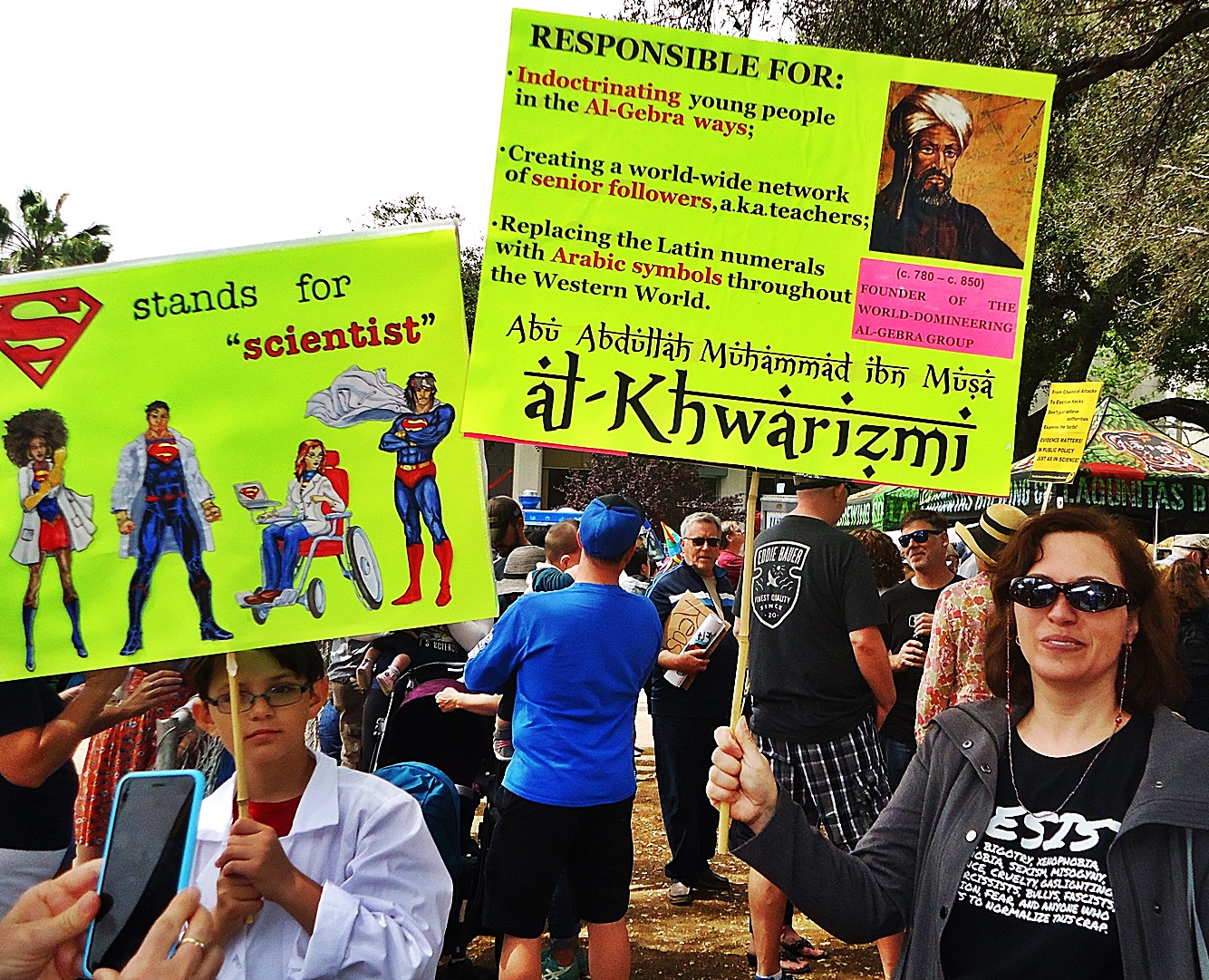
The math-themed signs were especially fascinating. Charles, a biophysics PhD from UCSF wanted everyone to know why the irrational number Pi matters: “3.14159 makes everything just so fine!” Crystal’s message was simple with profound implications: “I love Math.” But the most incisive message came from Dora and her 6th-grader son, Adrian who had designed posters praising the contributions of 8th-century mathematician al-Khwarizmi, considered the father of algebra. Married to an American, Dora is a Bulgarian who was praising a Muslim mathematician from olden times! Only in immigrant-rich America was this possible.


Tracy Van Houten, a rocket scientist at NASA’s Jet Propulsion Laboratory (JPL), also extolled the value of STEM, particularly for girls and minorities. “Scientists are underrepresented in our government,” she said. Of the 535 members of the Two Houses of Congress, only 11 are scientists. “That’s less than 2 percent! We have to not only protect science but also scientists,” she said. “We will prevail because Trump fears facts and facts are on our side.” Houten had to recently make a wrenching decision. “I was exploring the universe but gravity pulled me back to earth. I loved my job at the JPL,” she said, “but I felt the fierce urgency of now, this calling to rescue our country from partisan muck and science-deniers and put science back at the center of decision-making.” After Trump’s election, she quit her JPL job and is now running to represent the 34th Congressional District of California in the Congress.

The rally was billed not as a protest but as a march to affirm the value of science and to demand that the Trump administration use facts rather than polarizing and paralyzing ideologies to frame policies. We have a president who ignores evidence in favor of opinion, who has picked, as administrator of the Environmental Protection Agency (EPA), a man who denies that carbon dioxide is a primary source of global warming. Trump’s proposed budget would cut $12.6 billion from the Department of Health and Human Services, including $5.8 billion from the National Institute of Health alone, with potentially disastrous consequences for medical research. His ban on immigration threatens our scientific institutions like MIT, a significant percentage of whose faculty is foreign-born.


What will it mean for America if Trump has his way? Byron, a marine biologist, shared his perspective with me at the rally. “I don’t believe Trump will succeed. He will probably be neutered by division within his own party. His policies are likely to grind to a halt. But we can never be sure, so we have to keep up the momentum.”

The most moving moment at the rally came when I ran into 14-year-old Justin, a sophomore at the local Bellarmine College Preparatory. Justin suffers from Wilson’s disease, a rare inherited disorder caused by the mutation of a certain type of gene that leads to liver inflammation and reduced kidney function. “If it were not for drugs like syprine developed by scientists at 
Wilson’s Disease Association
, I wouldn’t be here. I owe my life to medical science.”


Friday, February 09, 2007

Filtering out the Arsenic of Corruption

As Bangladeshis watch enthralled the reeling in of the corrupt 'big fish' by the military-backed caretaker government, and let out a collective exultation of “finally!”, an event in the United States has added to this exultation.

Dr. Abul Hussam, a chemistry professor at George Mason University in Fairfax, Virginia, won the 2007 “Grainger Challenge Prize for Sustainability” for developing an inexpensive, easy-to-make system for filtering arsenic from well water. Of Bangladeshi origin, the chemist plans to donate the $1 million prize money for distributing these filters to needy communities around the world.

Dr. Hussam was moved by the plight of millions of Bangladeshis poisoned by tube-well water laced with arsenic - leading to serious skin conditions, tumors, breathing difficulties, cancer, and ultimately to agonizing death - and made it his quest to find a solution.

After experimenting with hundreds of prototypes, he finally found the right combination of sand, charcoal, brick and cast iron to filter out almost any trace of arsenic from well water. In the northern district of Kushtia now, these systems are being produced at the rate of about 200 per week, at a cost of about $40 each. Over 30,000 filtration systems have already been distributed throughout the country.

Coming in the wake of Dr. Yunus’s Nobel Peace Prize last year, Dr. Abul Hussam’s achievement should lift the heart of even the most stubborn pessimist.

In light of Bangladesh’s current attempt to make corrupt kingpins accountable for their past misdeeds, the success of Dr. Hussam’s discovery suggests a compelling question: Will Bangladesh be able to filter out the arsenic of corruption, greed, nepotism and misrule once and for all from the roots of its government, no matter who may be in power?

Conscientious Bangladeshis hung their heads in shame when the Berlin-based Transparency International ranked the country as the most corrupt in the world five years in a row, beginning with 2000. They witnessed with horror the powerful and the unscrupulous looting the country’s treasury, the Faustian bargains political parties made with one another and the terribly widening gap between the rich and the poor. (What a contrast, for instance, to a Bangladeshi taxi driver in New York named Osman chowdhury who returned a lost bag of diamond rings worth $500,000 to the owner after she had left it in the trunk of his cab. If only Bangladeshi politicians and their sycophants could learn honesty and integrity from this humble man!)

Both the Awami League and the Bangladesh National Party indulged in thievery and gangsterism with impunity, and functionaries of both parties – mercenaries, really - created a twilight zone in which their words were the law. Only the ‘fittest’ thrived in this twilight zone, the fittest being those in or close to power, and their henchmen down the food chain.

Now there is hope that the darkness may be lifting, that those who abused power and amassed fortunes at the expense of the nation and its citizens will be brought to justice.

Because it is the army, backed by the interim government, that is spearheading the crackdown and the cleansing mission, some Bangladeshis are already protesting that democracy is in danger.

What planet are they on? Democracy cannot flourish in a vacuum. It can thrive only in the fertile soil of accountability, responsibility, and good governance. When the soil is saturated with the arsenic of greed, nepotism and solipsism, what thrives is “thugocracy,” not democracy. This has been the sad lot of Bangladeshis since 1991, following the overthrow of the military dictatorship of General Ershad.

The country has been kept afloat not by any government in power, but by the innate genius of common Bangladeshis – the human capital - and their entrepreneurship and creativity against all odds.

What is critical is for the interim government to proceed with prudence, and not try to bite off more than it can chew. One measure of this prudence can be seen in the systematic way in which the army is being used to snag progressively ‘bigger fish’ with each passing day. Ultimately the biggest fish – an unholy group of crooks and criminal masterminds across party lines – will have to be hauled in for justice to prevail.

Visiting Bangladesh last November, friends and relatives repeatedly told me that if only the government got off the back of the people and the powerful were held accountable for their actions, the country could achieve wonders. While neighboring India was earning billions of dollars in foreign exchange through the Internet-driven boom in IT services and products, Bangladesh was moving backward through debilitating strikes and plundering of the nation’s assets by the privileged.

Will decades of national nightmare be soon over, and will a new and responsible government usher in an era of enlightened democracy, of accountability, of law and order, of economic and educational opportunity for all? Let’s hope the groundwork is now being laid for such an outcome, so that future generations can look to this interim government as one that, after fits and starts, found its calling and made good on its promise.