Sunday, September 09, 2018

Raising Student Success Rate in California's Community Colleges

You can also read the article in the San Jose Mercury News


The dropout and failure-to-graduate rates in California’s 72-district, 114 community colleges serving over 2.1 million students are unacceptable. A study by the Institute for Higher Education Leadership at Cal State Sacramento found that 70 percent of community college students fail to graduate or transfer to a four-year institution. These students typically drop out without any degree but with considerable debt.

One strategy used to redress this grim reality was to pour resources into remedial math and English courses, populated disproportionately by African-American and Latino students. It failed abysmally. Only 18 percent of elementary algebra students completed transfer-level math to CSU and UC systems in three years, and only 6 percent of pre-algebra students.
Something radical had to be done. Enter Assembly Bill 705. Introduced by Jacqui Irwin, D-Thousand Oaks, it was signed into law by Gov. Jerry Brown on Jan. 1, giving community colleges a deadline for full implementation by the fall of 2019.
The two revolutionary aspects of the bill are: a) colleges must maximize the probability that a student enter and complete transfer-level coursework in math and English within one year and b) colleges must use high school coursework, high school grades or high school GPAs to place incoming students into transfer-level courses, providing concurrent support as needed.
To appreciate the radical nature of AB 705, consider what I have witnessed with heartbreaking regularity in my years of teaching math. Joe, a high-school graduate with a 3.0 GPA, enrolls in his local college as a springboard for admission to UC Davis to major in sustainable agriculture. He expects to spend at most 3 years to accumulate enough units to transfer. Without delving into his aspirations, however, the college gives him an impersonal placement test where he falters with fractions. He gets trapped into a three-semester sequence of non-transferable basic skills classes of pre-algebra, algebra 1 and 2. He manages to pass the first two but algebra 2, with complex conjugates, quadratic equations and such, proves insurmountable. Overcome by emotional and psychological problems, Joe drops out and accepts a low-wage job below his potential.
AB 705 recognizes that it is the structural problem of under-placement and long sequence of classes that prevent students like Joe from graduating. Under AB 705, Joe is placed in transferable statistics in his very first semester, with help in math provided as just-in-time or co-requisite remediation. Excited by the relevance of the predictive power of statistics to his major, Joe aces the course. In a year, he completes transfer-level math and English requirements for a four-year institution.
Pipe dream? No. Pilot projects at San Diego’s Cuyamaca College and San Bruno’s Skyline College among others have shown that placing students in transferable math and English courses based on high school GPA quadruples the completion rate.
AB 705 has its challenges and detractors. Some claim it is too draconian. Others, that it was forced down from above without adequate faculty consultation. These are legitimate concerns, but the overriding factor for embracing AB 705 is that through proper placement and emphasizing acceleration over remediation, it can lift students from failure to success.

The Golden State has the fifth largest economy in the world, after the United States, China, Japan, and Germany. Its demand for a skilled, innovative workforce is skyrocketing. California’s community colleges must play a significant role in nurturing and educating this workforce. Faculty, counselors and administrators must work together to help students reach the high bar set by AB 705. Knowingly or unknowingly, we have been guilty of the soft bigotry of low expectations, with minority students bearing the brunt of our casually cruel mindset. We wrongly focus on what our students don’t know rather than what they know. The pilot projects have shown that students rise to the challenge of higher expectations. By demanding more, we can not only help our students succeed academically but also guide them toward a life of meaning and purpose.

Saturday, August 11, 2018

To Refresh the Soul, Became An Islander for a Week

Escaping from smart gadgets, social media and the incessant outrages of a poisonous presidency, became an islander for a week this summer. Victoria, capital of British Columbia in Canada, is a nature-lover’s paradise. A day after arriving, headed for Butchart Gardens. Among the floral wonders of the world, surely this one must rank among the top five. Driving past picturesque farms and placid lakes, I finally enter the garden of my imagination. 

On the way to Butchart Gardens
It was everything I thought it would be, only more. The rose garden alone has over 2,500 plants, comprising 250 varieties. Their names and the year they were planted add to the romance of the roses: Winter Sun (Germany, 2001), Gold Struck (France, 2012), Always & Forever (USA, 2011), Sunshine Daydream (France, 2006), Opening Night (USA, 1998), Candella (New Zealand, 1996), All My Loving (England, 2011), Bride (England, 1995), Lasting Love (France, 1993), and many more. And the waterfall in the sunken garden? Must savor it to believe it!


About 10 miles away is the Butterfly Garden where I counted about 30 species of iridescent beauties fluttering around me and teasing me as I tried to get the perfect shot in my camera. They fly tantalizingly close but at the last moment veer away. Two hours passed in two minutes. It’s true: When you are spellbound by transcendent wonders, time sprints.


Next day, it’s the Abkhazi Garden in a leafy residential section of Victoria. It’s the garden that love built, result of an unlikely romance between a Russian prince, Nicholas Abkhazi, and Peggy Pemberton-Carter, adopted daughter of a wealthy British couple living in Shanghai. They crossed path in Paris and became friends. World War II intervened and the pair lost track of one another. Decades later, they met in New York after the War. In Peggy’s words: “We met again, we married, we lived happily ever after (40+ years!), and we created a garden.” If you visit, don’t miss the classy Afternoon Tea in the Teahouse, after a leisurely stroll past the rhododendrons, water lilies and the baby-blue hydrangeas.


Took a ferry – more like a cruise ship – to Vancouver one day and to Salt Spring Island, one of the many Gulf Islands around Victoria, the following day. Vancouver is just like San Francisco, another big city with congested traffic and harried tourists. But Salt Spring Island, well, that’s another story. This quaint island, home to about 12,000 hardy but contented souls, is full of charming boutique shops and eclectic restaurants serving food that only islanders can: Out of this world. There was also humor in front of a restaurant at Fulford Harbor, giving a spin to Einstein's famous formula.


One mystery that baffled me: The river Ganges flows through India and assumes the name Padma when it flows through Bangladesh. So what exactly is "Ganges Alley" doing in Salt Spring Island, 7000 miles and several oceans away from Ganges-Padma? Oh well!


Why travel to bask in the wonders of nature? Found the answer in downtown Victoria, in the splendid Beacon Hill Park.


Saturday, June 30, 2018

"Families Belong Together" Rally in San Jose, California

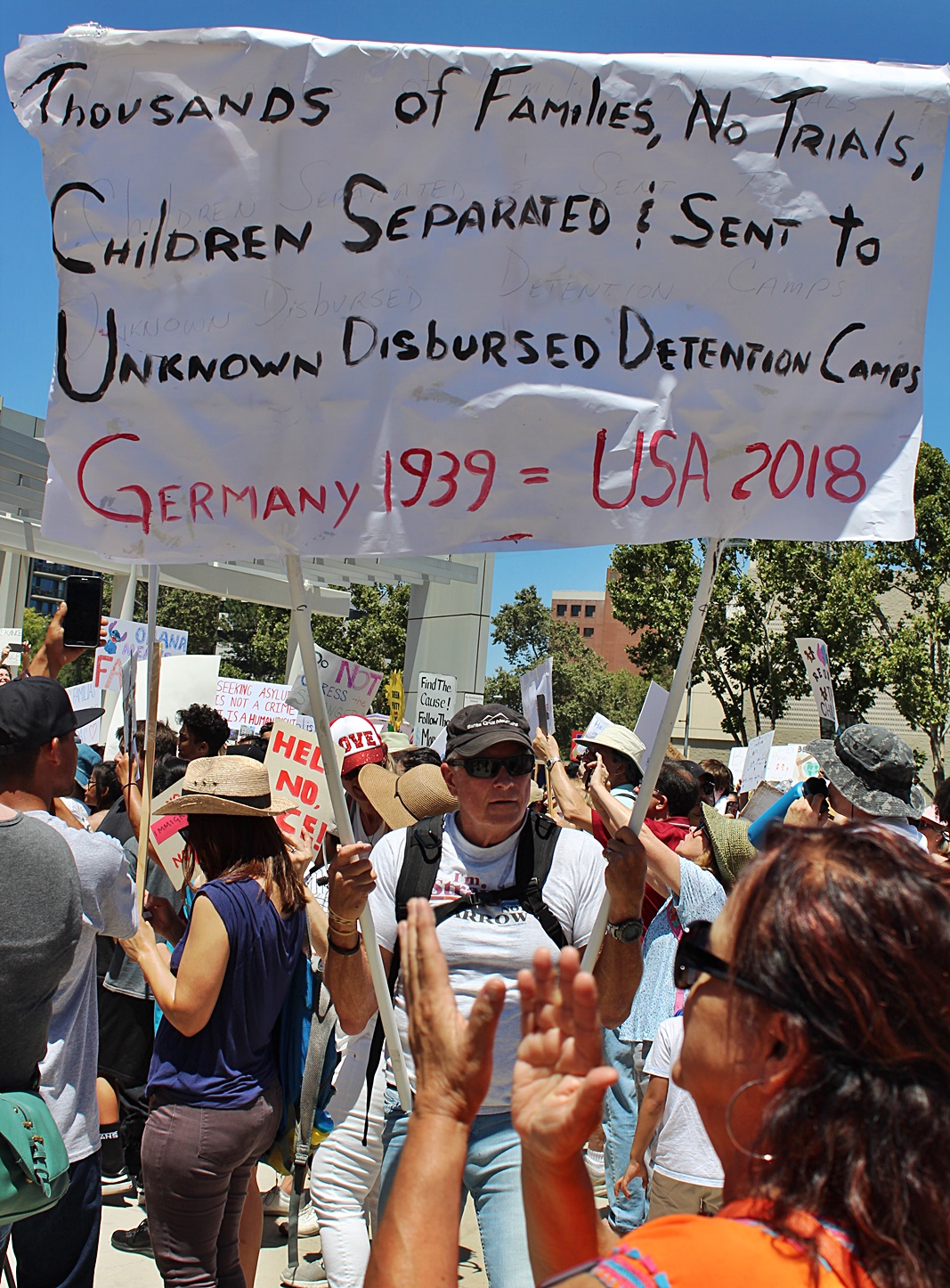
On a sweltering sunny summer afternoon on this last day of June 2018, when we could have been at the shore relaxing and watching the waves of the Pacific roll in, about 1,000 of us gathered in the plaza in front of City Hall in downtown San Jose to protest Trump Administration's inhuman practice of separating children from their parents at the border and caging them like animals. We were joining millions of our fellow-Americans in 750 cities across the nation in telling the Trump administration in loud and clear voices that "Families Belong Together."

"Whose Children?" asked the man with mike. "Our children," we responded. 

"A People United 
Can Never be Divided," we thundered. Cars honked, and drivers raised their fists in support.

"This is what Democracy Looks Like!" declared one of the organizers from the podium. "Yes," we echoed, "This is what Democracy Looks Like."

Nothing will change, said one of the speakers, unless we vote. "Will you vote," she asked? "Yes, yes, we will vote," we said in unison. 

"Zero-tolerance for Trump's 'Zero-Tolerance' policy," we asserted. Children brought cages to dramatize the cruel policy of ICE snatching babies away from their nursing mother's arms. "Amber Alert: ICE kidnapping children," shouted an activist from the stage.

The posters captured our spirit and passion as powerfully as the speeches by ordinary folks, activists, immigrants and politicians opposed to Trump's policies.

Here are some photographs I took of this passionate event in downtown San Jose today, June 30, 2018, that I hope will give you an idea of how we Americans around the nation are seeking to save the soul of our nation being relentlessly destroyed by Trump and his sycophants.